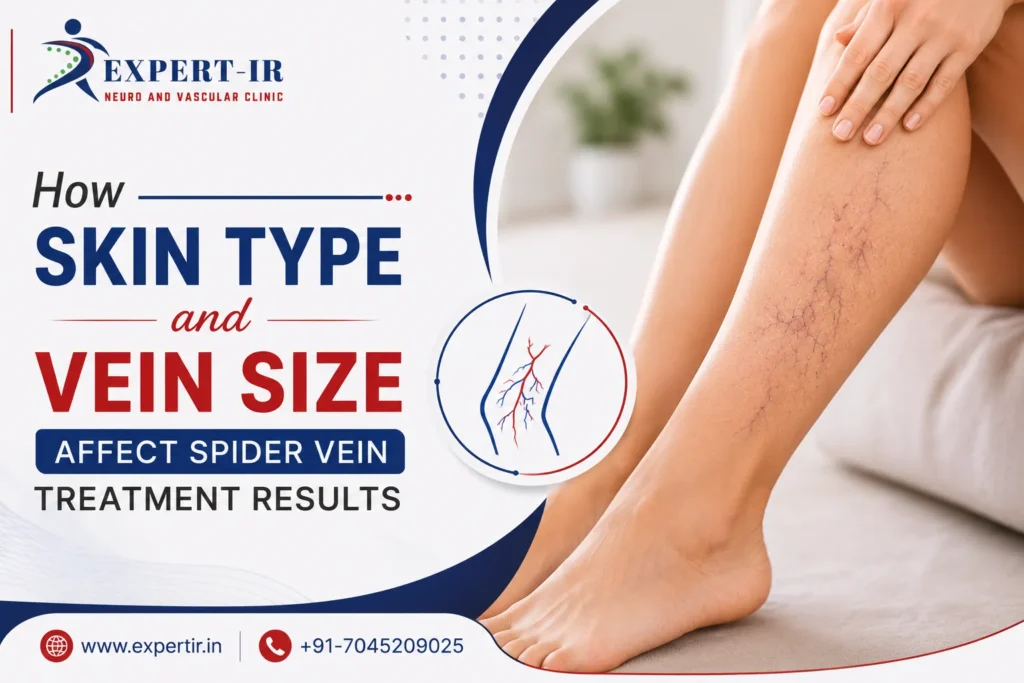
How Skin Type and Vein Size Affect Spider Vein Treatment Results
Spider veins may look like a simple cosmetic concern, but treatment results depend on several factors—including the size, depth, color, location of the veins and the patient’s skin type.
Two people can have similar-looking spider veins but respond differently to the same treatment. A treatment that works well for one person may require a different approach, more sessions, or additional precautions for another.
So, does skin type affect spider vein treatment? Does vein size matter? Yes. Both can influence treatment selection, the number of sessions required, the risk of temporary pigmentation, and how quickly the treated veins fade.
Understanding these factors can help set realistic expectations and improve treatment planning.
What Are Spider Veins?
Spider veins, medically known as telangiectasias, are small, widened blood vessels that appear close to the skin’s surface.
They commonly look like:
- Fine red lines
- Blue or purple veins
- Branching patterns
- Web-like clusters
They are most frequently found on the:
- Thighs
- Calves
- Ankles
- Around the knees
Spider veins are usually harmless, but in some people they occur alongside underlying venous insufficiency. This is why treating the visible veins without checking the underlying circulation may not always produce the expected long-term result.
Does Skin Type Affect Spider Vein Treatment Results?
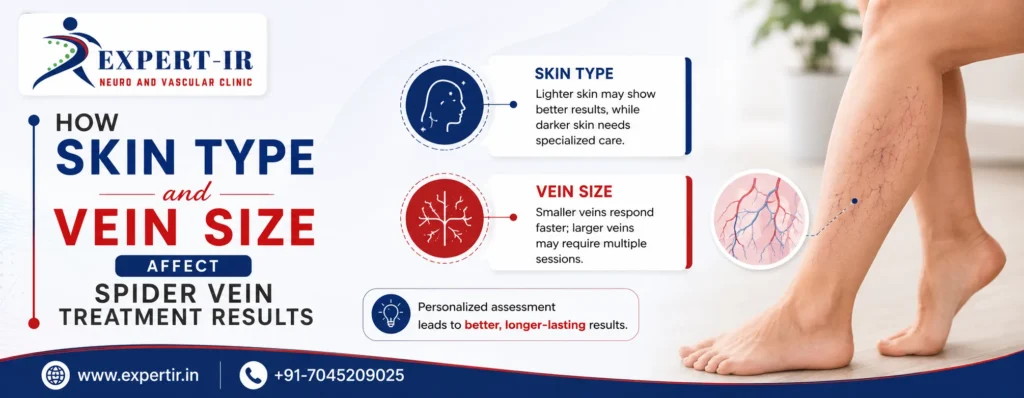
Yes, skin characteristics can influence treatment planning and the risk of temporary skin changes. However, it is more accurate to consider skin pigmentation and sensitivity, rather than simply labeling someone by a particular skin type.
Darker or more heavily pigmented skin may require additional precautions with certain light- or laser-based treatments because the treatment energy can interact with melanin in the skin.
This can increase the risk of:
- Temporary darkening (hyperpigmentation)
- Lightening of the skin (hypopigmentation)
- Burns or other pigment-related changes if inappropriate settings are used
This does not mean people with darker skin cannot undergo spider vein treatment. It means the treatment method and energy settings should be selected carefully.
Effect of Spider Vein Results on Lighter Skin
People with lighter skin may have greater visual contrast between the skin and the blood vessels, making some spider veins easier to identify clinically. However, lighter skin does not automatically mean faster or better treatment.
Other factors remain important, including:
- Vein diameter
- Vein depth
- Vein color
- Number of veins
- Underlying venous reflux
- Treatment technique
How Vein Size Changes the Treatment Plan
Not every visible vein is the same size, and size is usually the first thing a vascular specialist checks before recommending a treatment.
Telangiectasia (True Spider Veins): Under 1 mm
These are the fine, thread-like veins most people mean when they say “spider veins.” At under 1 mm in diameter, they respond well to both sclerotherapy and surface laser treatment, since they are small enough for a laser to target directly without much heat spreading to surrounding skin.
Reticular Veins: 1 to 3 mm
These slightly larger, bluish veins often sit just beneath the spider veins and feed them. Sclerotherapy tends to outperform laser here, because an injected sclerosant reaches the full length of the vein rather than just the surface a laser can see.
Larger Feeder and Varicose Veins: 3 mm and Above
Veins at this size are usually not “just” spider veins. They often indicate an underlying reflux problem in a deeper or truncal vein, where blood is pooling and pushing pressure into the smaller veins above it. Treating the surface spider veins alone in this case rarely holds, because the source vein keeps refilling them. This is where endovenous options like radiofrequency ablation or VenaSeal come in, closing the source vein so the surface veins can be treated with lasting results.
| Vein type | Typical size | Best-suited treatment |
|---|---|---|
| Telangiectasia (spider veins) | Under 1 mm | Sclerotherapy or surface laser |
| Reticular veins | 1 to 3 mm | Sclerotherapy (laser less effective) |
| Feeder or varicose veins | 3 mm and above | Endovenous ablation (RFA or VenaSeal), then surface treatment |
Why Darker Skin May Require Extra Care
With laser or light-based procedures, melanin absorbs some wavelengths of light. If the treatment energy is not appropriately selected for the patient’s skin pigmentation, there may be greater risk of unwanted pigment changes.
Therefore, for patients with darker skin, a vascular specialist may consider:
- Appropriate wavelength selection
- Conservative energy settings
- Test spots where appropriate
- Careful monitoring
- Alternative treatment techniques
Skin tone should influence treatment planning—not prevent someone from seeking treatment.
Does Vein Size Affect Spider Vein Treatment?
Absolutely.
Not all spider veins are the same.
They can vary considerably in:
- Diameter
- Depth
- Color
- Blood flow
- Location
- Number
A very fine red spider vein may require a different approach from a larger blue reticular vein.
Matching Treatment to Your Vein Size and Skin Type
Good treatment plan sits at the intersection of both factors rather than treating them separately.
- Fine spider veins (under 1 mm) on fair to medium skin: surface laser or sclerotherapy both work well.
- Fine spider veins on medium to dark skin: sclerotherapy is often favored, or laser with a longer wavelength like Nd:YAG to limit pigmentation risk.
- Reticular veins (1 to 3 mm) on any skin tone: sclerotherapy is typically the more reliable choice.
- Larger feeder veins (3 mm and above) with visible surface spider veins: the underlying vein needs to be closed first, through radiofrequency ablation or VenaSeal, before surface treatment will hold.
Sclerotherapy vs Laser: Which Is Better?
The right choice depends on the characteristics of the vessels.
Sclerotherapy
Sclerotherapy involves injecting a sclerosant into the targeted vein. The solution causes the vessel to close, after which the body gradually absorbs the treated vein.
It is commonly used for:
- Spider veins
- Reticular veins
- Selected small varicose veins
Advantages
- Effective for many superficial veins
- Particularly useful for veins that are slightly larger or deeper
- Can treat multiple vessels during a session
Vascular Laser Treatment
Laser treatment uses targeted light energy to heat and close selected superficial blood vessels. It may be useful for certain:
- Very small vessels
- Fine red spider veins
- Superficial telangiectasias
The choice of laser wavelength and settings is particularly important when treating different skin pigmentation levels.
Why Spider Veins Come Back After Treatment
If spider veins return within months of a “successful” treatment, the usual cause is not that the treatment failed. It is that a larger feeder vein below the surface was never addressed, and it continues to push pressure into the smaller veins. This is a common reason patients seek a second opinion after treating only what they could see. A vein mapping ultrasound before treatment helps catch this before it becomes a repeat expense.
Compression stockings after treatment also play a bigger role than most patients expect, particularly in supporting healing and reducing the chance of new veins forming in the treated area.
Spider Veins Sessions, Timelines, Fading
Fine spider veins usually need 1 to 3 sclerotherapy or laser sessions, spaced 4 to 6 weeks apart.
Reticular and feeder veins may need additional sessions or an endovenous procedure before surface veins are treated.
Fading typically begins within 2 to 4 weeks but can continue improving for up to 3 to 6 months.
Darker skin tones may see temporary discoloration at the treatment site before final fading, which is a normal part of healing, not a treatment failure, though it can take longer to resolve than in fairer skin.
Does a Doppler Ultrasound Help Before Spider Vein Treatment?
For isolated, uncomplicated spider veins, an ultrasound may not always be necessary. Evaluation for underlying venous disease becomes particularly important when a patient has:
- Leg pain
- Heaviness
- Swelling
- Varicose veins
- Recurrent spider veins
- Skin changes
- Previous vein treatment with recurrence
A venous Doppler ultrasound can identify significant reflux in larger veins that may be contributing to the visible network.
What Can Affect Spider Vein Treatment Results?
Skin and vein size are important—but they are not the only factors.
Results can also be influenced by:
Vein depth
Deeper vessels may respond differently from superficial ones.
Vein color
Red, purple, and blue vessels may respond differently to different treatment technologies.
Underlying venous reflux
Untreated reflux can contribute to recurrence.
Hormonal factors
Pregnancy and hormonal changes can influence vein development.
Genetics
Some people are naturally more prone to developing spider veins.
Treatment technique
Incorrect treatment selection or settings can affect both results and side effects.
Aftercare
Following post-treatment instructions can support recovery.
How to Improve Your Spider Vein Treatment Results
You can support treatment by:
- Following your specialist’s aftercare instructions
- Staying physically active
- Avoiding prolonged standing where possible
- Maintaining a healthy weight
- Using compression when specifically recommended
- Protecting treated skin from excessive sun exposure
- Attending follow-up appointments
Avoid self-treating persistent or recurrent spider veins without determining whether an underlying venous problem exists.
Role of Expert IR Neuro & Vascular Clinic in Spider Vein Treatment
At Expert IR Neuro & Vascular Clinic, spider vein treatment begins with understanding what type of veins are actually being treated.
Under the care of Dr. Santosh Patil, patients can undergo a clinical assessment to determine:
- Vein size and distribution
- Whether larger feeder veins are present
- Whether symptoms suggest underlying venous insufficiency
- Whether Doppler evaluation is appropriate
- Which minimally invasive treatment is best suited to the individual
Depending on the vein characteristics, treatment may involve sclerotherapy or other image-guided/minimally invasive techniques.
The goal is not simply to make visible veins disappear temporarily. It is to identify the source, choose the appropriate treatment, and set realistic expectations for long-term results.
Conclusion
Skin pigmentation and vein size can both influence spider vein treatment planning and results—but neither should be considered in isolation.
The most important factors are:
Skin characteristics + vein size + vein depth + vein type + underlying venous circulation + appropriate treatment selection
Very fine superficial vessels may respond differently from larger reticular veins, while patients with more pigmented skin may require additional precautions with certain laser-based treatments.
If spider veins are recurring, spreading, or associated with swelling, heaviness, or pain, don’t treat them as purely cosmetic. A vascular assessment can determine whether an underlying venous problem is contributing.
Frequently Asked Questions (FAQs)
Yes. Skin pigmentation can influence the choice and settings of laser or light-based treatments and may affect the risk of temporary pigmentation changes. Treatment should be customized to the individual.
Yes. Darker skin does not prevent spider vein treatment. However, certain laser or light-based procedures may require additional precautions because of the interaction between treatment energy and melanin.
Yes. Very fine superficial spider veins, larger reticular veins, and feeder veins may require different treatment approaches.
Not necessarily. Very fine vessels can sometimes be technically challenging because they require precise treatment. The appropriate technique depends on their color, depth, size, and location.
Neither is universally better. Sclerotherapy is commonly used for many spider and reticular veins, while vascular laser treatment can be useful for selected superficial vessels, particularly some fine red veins.
Different veins respond at different rates, and larger or more extensive networks may require several sessions. Underlying feeder veins may also need to be addressed
Yes. Treated vessels can be successfully closed, but new spider veins may develop over time due to genetics, hormones, aging, pregnancy, or underlying venous disease.
Not every person with isolated spider veins requires an ultrasound. However, Doppler evaluation may be appropriate when spider veins are associated with swelling, pain, heaviness, varicose veins, recurrence, or other signs of venous insufficiency.
No. Compression stockings may help manage symptoms and support venous circulation, but they do not permanently remove established spider veins.
Results are gradual. Treated vessels may fade over several weeks or months depending on the treatment used, vein characteristics, and individual healing response.
Sun exposure can increase the risk of pigmentation problems after certain treatments, particularly in susceptible individuals. Follow your specialist’s advice regarding sun protection during recovery.