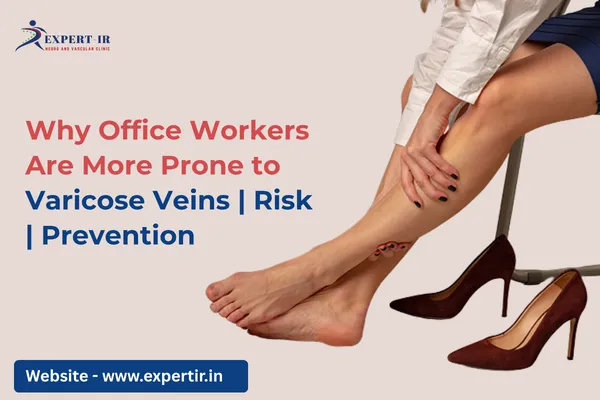
Why Office Workers Are More Prone to Varicose Veins | Risk | Prevention
If your workday involves sitting at a desk for 8–10 hours, you may have noticed that your legs feel heavy, tired, swollen, or uncomfortable by evening. For some people, tiny spider veins eventually become more prominent, twisted varicose veins.
But can a desk job actually cause varicose veins?
Not by itself. The underlying problem is usually venous valve dysfunction, which allows blood to flow backward and accumulate in the legs. However, prolonged sitting, limited physical movement, excess weight, and other workplace-related factors can contribute to venous pooling and make symptoms more noticeable.
For office workers, the important question isn’t simply “How can I prevent visible veins?” It is:
Could my daily work routine be allowing an underlying vein problem to progress?
Let’s understand what happens inside the veins, who is most at risk, and what you can do about it.
What Happens to Your Veins When You Sit for Hours?
Your leg veins have a difficult job: they have to transport blood upward against gravity toward your heart. To make this possible, veins contain small one-way valves. Your calf muscles also act as a muscle pump, compressing veins when you walk and helping push blood upward.
When you’re walking: Calf contraction → vein compression → blood moves upward → valves prevent backflow
When you’re sitting for hours with very little leg movement: Reduced calf activity → less muscle-pump action → slower venous return → increased blood pooling
In someone with healthy valves, this may not cause a major problem. But if the valves are already weak or damaged, prolonged inactivity can contribute to venous hypertension and worsening symptoms.
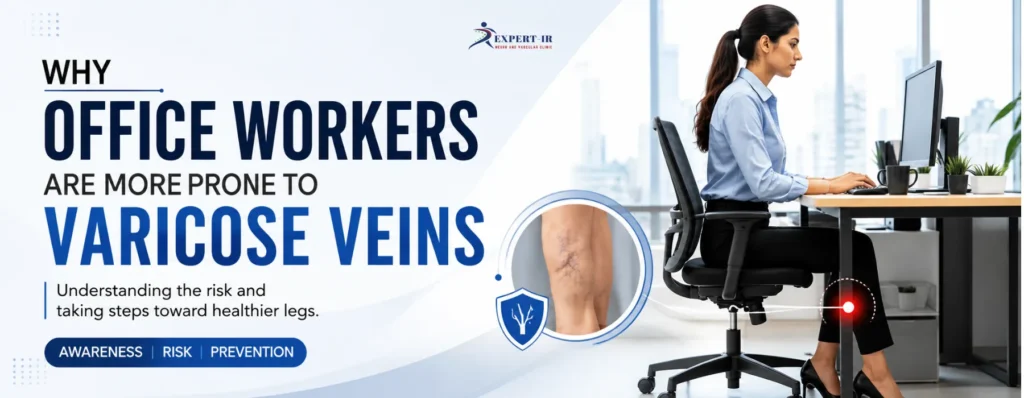
Does Sitting All Day Directly Cause Varicose Veins?
No. This is an important distinction.
A desk job is a risk factor, not necessarily the root cause. Varicose veins usually develop because of chronic venous disease and venous reflux. Genetics, age, pregnancy, obesity, previous vein problems, and prolonged periods of sitting or standing can all influence the likelihood of developing symptomatic disease.
Think of it as:
Weak vein valves + gravity + prolonged inactivity → increased venous pressure → reflux → vein enlargement
This explains why one office worker may develop prominent varicose veins while another person with the same sitting schedule does not.
7 Reasons Office Workers Develop or Worsen Varicose Veins
1. Long Periods of Uninterrupted Sitting
The biggest workplace issue isn’t simply sitting—it is sitting continuously without moving. A typical office worker may spend hours:
- Working on a computer
- Attending virtual meetings
- Reading documents
- Taking phone calls
- Commuting to and from work
During these periods, the calf muscles remain relatively inactive.
2. Reduced Calf-Muscle Pump Activity
Walking is one of the simplest ways to activate the calf-muscle pump. If most of your day is spent sitting, there are fewer calf contractions helping blood return toward the heart.
This can contribute to leg heaviness and swelling, particularly later in the day.
3. Prolonged Sitting During Commutes
The problem may not end when you leave the office.
Long commutes by:
- Car
- Bus
- Train
- Flight
can add several more hours of limited movement. For someone already experiencing venous insufficiency, the cumulative effect can make evening symptoms more noticeable.
4. Working From Home Can Increase Sedentary Time
Remote work has changed how many people spend their day. Without walking between meeting rooms, visiting colleagues, or moving around an office, daily activity can decrease significantly.
A person may go from:
Desk → sofa → bed
with very little walking in between.
5. Weight Gain and Metabolic Risk Factors
A sedentary routine can contribute to weight gain.
Excess body weight is associated with a higher risk of chronic venous disease and can place additional stress on the venous system.
6. Prolonged Standing Is Also a Problem
Not all workplace-related vein problems come from sitting.
People who spend most of their working day standing—such as:
- Teachers
- Healthcare workers
- Retail employees
- Salon professionals
- Security personnel
may also experience increased venous pressure.
The common issue is prolonged time in one position.
7. Ignoring Early Symptoms
This may be the most important factor.
Many professionals dismiss:
“My legs are just tired from work.”
But recurring heaviness, swelling, aching, or night cramps may indicate an underlying venous problem.
Early Signs of Varicose Veins Office Workers Ignore
Varicose veins don’t always begin as large, visible, bulging veins.
Watch for:
Leg heaviness
Your legs feel unusually heavy toward the end of the workday.
Ankle swelling
Shoes or socks feel tighter in the evening.
Aching or throbbing
Discomfort increases after prolonged sitting or standing.
Night cramps
Recurring calf cramps disturb your sleep.
Burning or itching
The skin around visible veins may feel irritated.
Visible spider or reticular veins
Small blue, purple, or reddish veins may become increasingly prominent.
Relief after elevation
Symptoms may improve when you lie down or elevate your legs.
The pattern matters. Symptoms that repeatedly worsen toward evening and improve with movement or leg elevation are worth discussing with a vein specialist.
8 Practical Ways Office Workers Can Protect Their Veins
1. Break Up Long Sitting Periods
Don’t wait until the end of the workday to move. Set a reminder to stand, walk, or move your legs periodically throughout the day.
Even short movement breaks are preferable to remaining stationary for hours.
2. Activate Your Calf Muscles at Your Desk
If you cannot leave your workstation, perform simple movements such as:
- Ankle pumps
- Heel raises
- Toe raises
- Ankle circles
These don’t replace walking, but they provide regular lower-leg movement.
3. Walk During Meetings When Possible
Consider:
- Walking during phone calls
- Walking to speak with colleagues
- Taking stairs when appropriate
- Taking a short walk during lunch
The goal is to increase total daily movement, not simply complete one workout.
4. Avoid Sitting in the Same Position
Change your position regularly. If you use a standing desk, alternate between sitting and standing rather than standing continuously for several hours.
Movement matters more than simply switching from one static position to another.
5. Maintain a Healthy Weight
A balanced diet and regular exercise can support overall cardiovascular and vascular health.
Weight management is particularly important when obesity is contributing to venous symptoms.
6. Elevate Your Legs When They Feel Heavy
After work, elevating the legs can temporarily reduce venous pressure and swelling. However, leg elevation is a symptom-management strategy, not a treatment for faulty vein valves.
7. Consider Compression When Medically Appropriate
Compression stockings can help reduce symptoms such as:
- Leg swelling
- Aching
- Heaviness
However, they should be appropriately fitted and selected based on your individual condition.
People with suspected arterial circulation problems should seek medical advice before using compression.
8. Don’t Self-Treat Persistent Symptoms Indefinitely
Walking and lifestyle changes are valuable.
But if your symptoms continue despite these measures, don’t assume that increasing exercise will fix the problem.
Can Exercise Cure Varicose Veins?
Exercise cannot repair a damaged vein valve.
However, regular physical activity can:
- Improve calf-muscle pump function
- Support venous return
- Improve cardiovascular fitness
- Help maintain a healthy weight
- Reduce some symptoms
If Doppler ultrasound confirms significant venous reflux, additional treatment may be required.
What Are the Modern Treatment for Varicose Veins?
When treatment is indicated, modern management can often avoid traditional vein-stripping surgery.
Endovenous Laser Ablation (EVLA)
A thin catheter is inserted into the incompetent vein under ultrasound guidance. Laser energy is then used to close the vein. The blood is redirected through healthier veins.
Radiofrequency Ablation (RFA)
RFA uses controlled radiofrequency energy to close the diseased vein. It is another minimally invasive option for appropriately selected patients.
VenaSeal Treatment
VenaSeal uses a medical adhesive to close the incompetent vein without thermal energy. It may be suitable for selected patients based on their vein anatomy and clinical condition.
How Expert IR Neuro & Vascular Clinic Helps Office Workers
At Expert IR Neuro & Vascular Clinic, the focus is on determining why the patient’s veins are becoming symptomatic, rather than treating visible veins alone.
Under the care of Dr. Santosh Patil, patients can undergo clinical assessment and venous Doppler evaluation to identify abnormal reflux and determine the most appropriate management strategy.
When intervention is indicated, the clinic provides minimally invasive options such as:
- Endovenous Laser Ablation (EVLA)
- Radiofrequency Ablation (RFA)
- VenaSeal™ Glue Treatment
The objective is to treat the underlying source of venous reflux, relieve symptoms, and reduce the burden of chronic venous disease, while minimizing downtime where clinically appropriate.
Conclusion
A desk job doesn’t automatically cause varicose veins but spending most of the day sitting or standing without movement can contribute to venous pooling and worsen symptoms in people with underlying venous valve problems.
The most important distinction is this:
Lifestyle changes improve circulation and symptoms; they do not repair faulty vein valves.
If you are experiencing persistent leg heaviness, evening swelling, aching, night cramps, or increasingly prominent veins, a venous Doppler ultrasound can determine whether venous reflux is responsible.
When significant reflux is confirmed, minimally invasive options such as EVLA, RFA, or VenaSeal™ may provide a more definitive solution than simply managing symptoms.
Frequently Asked Questions (FAQs)
Prolonged sitting does not directly cause every case of varicose veins, but it reduces calf-muscle activity and can contribute to venous pooling and worsening symptoms, particularly when venous valve dysfunction already exists.
Prolonged sitting can reduce the calf-muscle pump and contribute to blood pooling in the legs. Recurrent evening swelling can also be a symptom of chronic venous insufficiency.
Avoid remaining completely stationary for prolonged periods. Getting up regularly to walk and performing ankle or calf movements during the workday can help maintain leg circulation.
Walking activates the calf-muscle pump and supports venous return. It can help reduce symptoms and support vein health, but it cannot repair already damaged vein valves.
A standing desk is not a complete solution. Prolonged standing can also increase venous pressure. The goal should be regular movement and changing positions, rather than replacing prolonged sitting with prolonged standing.
Some office workers may benefit from medical compression stockings, particularly if they experience leg swelling or heaviness. The appropriate compression level should be selected based on individual needs.
Exercise can improve circulation and reduce some symptoms, but established varicose veins caused by venous reflux generally do not disappear through exercise alone.
A venous Doppler ultrasound is commonly used to evaluate blood flow and identify venous reflux. It helps determine whether an underlying valve problem is responsible for the symptoms.
Consider an evaluation if you have persistent swelling, leg heaviness, aching, recurrent night cramps, increasingly prominent veins, skin changes, bleeding, or a wound around the ankle that is not healing.
Prolonged inactivity can aggravate symptoms and contribute to venous pooling. If significant venous reflux is already present, however, changing your sitting routine alone may not stop the underlying disease.
Age alone does not determine treatment suitability. If significant symptomatic venous reflux is confirmed, laser ablation may be considered after appropriate vascular assessment.