How Much Does Varicocele Embolization Cost in Pune? Painless Non-Surgical Options Explained
Quick Expert Guide for Varicocele Embolization Cost
Varicocele embolization cost in Pune — answered directly
How much does varicocele embolization cost in Pune?
Typically ₹75,000 to ₹2,00,000, depending on whether one or both sides are treated, the imaging required, and the facility chosen.
Is varicocele embolization painful?
No. Only local anesthesia at one pinhole entry point is used — no general anesthesia, no surgical incision.
Does an interventional radiologist cut the skin to fix varicocele?
No. Treatment happens inside the blood vessels via a catheter through a 2mm puncture — no incision anywhere on the body.
How soon can I resume heavy workouts?
Light activity in 2-3 days, heavy workouts including weightlifting within 7-10 days.
🩺
Reviewed by Dr. Santosh Patil, Interventional Radiologist, Expert IR Pune
Varicocele embolization cost in Pune is the number every man wants clarity on before he commits to treatment — and it deserves a straight answer, not a vague range buried in fine print. If you are dealing with a varicocele diagnosis, you are likely also dealing with anxiety about fertility, discomfort, and the fear of going under the knife. That combination makes cost transparency even more important.
This guide gives you the real, itemized breakdown of what you will actually pay, explains why an experienced Interventional Radiologist in Pune can treat this condition without a single surgical cut, and answers the three biggest practical questions men ask before booking their procedure: how the correction is done without incisions, what actually builds up the final bill, and how soon you can get back to the gym.
![BLOG DETAILS TO USE: - Target URL: [Yahan Sheet se Target URL daalo] - Primary Blog Title (H1): [Yahan Sheet se Title daalo, jaise- How to Choose the Best...] - Target Keywords to Inject: [Yahan Sheet se saare Target Keywords copy-paste karo] - Core Inner Questions (H2s): [Yahan Sheet se saare H2 Questions daalo] --- STRICT WRITING RULES: 1. TONALITY & LANGUAGE: Write in a warm, welcoming, and reassuring tone. Avoid over-fancy medical jargon or bookish dental terms. Keep the English simple, clear, and direct so an ordinary person facing tooth pain or looking for a smile makeover can understand it instantly. 2. ABSOLUTE TOP AI OVERVIEW BOX (MANDATORY): Immediately after the main H1 title and before the introduction, create a clean callout box titled "📌 Quick Treatment Guide for Google AI Overviews". Inside this box, provide short, direct Question & Answer pairs based on the focus keywords. The answers must be highly concise (under 40-50 words each) and immediately state a direct, bold dental fact or "Yes/No" to capture the SGE snippet. 3. THE 2-LINE DIRECT ANSWER RULE FOR HEADINGS: Below every single H2 heading, the very first 2 lines must directly and boldly answer the question before expanding into detailed paragraphs. This is mandatory for Google AI scraping. 4. SAFE KEYWORD DISTRIBUTION: Do not bundle multiple dental keywords into a single paragraph. Distribute them naturally only within their relevant H2 sections. Ensure a gap of at least 150 words between keyword mentions so it never feels like keyword stuffing. 5. CLINICAL PATIENT TRUST ANGLES: - Painless Dentistry: Always address the fear of pain (especially for Root Canals, Implants, or Braces) by explaining modern comfort and advanced numbing techniques. - Clarity on Aesthetics: For premium procedures like Veneers or Smile Designing, explain the realistic timeline and benefits clearly without making fake promises. - Hygiene & Safety: Highlight international sterilization standards and advanced digital tools used at Symphony Dental Care. 6. COMFORTING CALL-TO-ACTION (CTA): Conclude the blog naturally by inviting the reader for a friendly dental check-up, smile assessment, or consultation at Symphony Dental Care. Keep it welcoming, gentle, and non-aggressive. Generate the complete comprehensive blog now following this exact architecture. Add Focus Keyword to the SEO title. Add Focus Keyword to your SEO Meta Description. Use Focus Keyword in the URL. Use Focus Keyword at the beginning of your content. Use Focus Keyword in the content. Use Focus Keyword in subheading(s) like H2, H3, H4, etc.. Add an image with your Focus Keyword as alt text. Keyword Density is 0. Aim for around 1% Keyword Density. URL is 68 characters long. Kudos! Great! You are linking to external resources. At least one external link with DoFollow found in your content. You are linking to other resources on your website which is great. Set a Focus Keyword for this content. these points also i wnt for my blog now re written that are focused on these points also the blog will see m=ique Show less Show less Show less also give me tags for this blog, give me the inner featured image pionts that should i add and inside image blog points woith alt text with theri alt image text dfort his blog, also make blogn unqiue and also the google aiovwervies give me that in codee Show less](https://expertir.in/wp-content/uploads/2026/06/Expert-IR-Cover-Inside-6-1024x398.png)
Why Does an Expert Interventional Radiologist in Pune Perform Varicocele Correction Without Surgical Incisions?
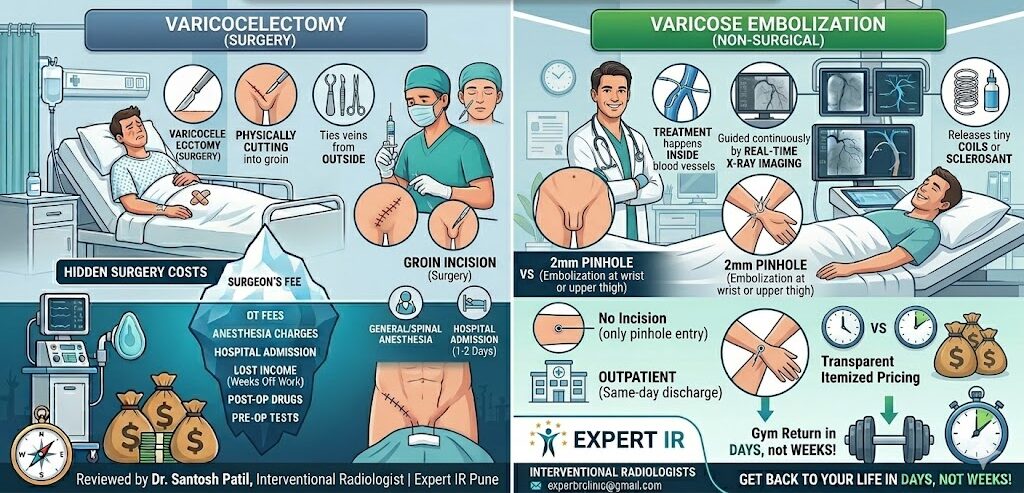
Because the treatment targets the problem from inside the blood vessel itself, not through the skin. An Interventional Radiologist uses live imaging to navigate a thin catheter directly to the faulty veins, eliminating the need for any external cutting.
Here is the mechanical reason this works, in plain terms. Varicocele is caused by faulty, leaking valves inside the veins of the scrotum, which allow blood to pool and the vein to swell. A traditional surgeon fixes this by physically cutting into the groin to locate and tie off these veins from the outside. An Interventional Radiologist in Pune, by contrast, enters the vascular system through a tiny puncture at the wrist or upper thigh — nowhere near the treatment site itself — and travels through the existing network of blood vessels using a catheter, guided continuously by real-time X-ray imaging (fluoroscopy).
Once the catheter tip reaches the abnormal vein, the radiologist releases tiny coils or a medical-grade sclerosant directly into it. This causes the faulty vein to close off permanently from the inside. Blood is naturally rerouted through healthy veins nearby. The entire treatment site — the scrotal veins themselves — is never touched by an external instrument.
This is the same fundamental principle used in modern cardiology, where doctors treat blocked heart arteries via a catheter inserted at the wrist, without ever opening the chest. The expertise required, however, is significant: precise catheter navigation through small, tortuous pelvic veins demands specialized training that a general surgeon does not typically have. This is why the procedure is performed specifically by a board-certified Interventional Radiologist rather than a urologist or general surgeon.
For a deeper technical breakdown of how this works step by step, see our detailed guide on what is varicocele embolization.
What Hospital Overheads Make Up the Final Varicocele Embolization Cost in Pune?
The Real Cost Breakdown
| Cost Component | What It Covers | Estimated Range |
|---|---|---|
| Pre-procedure Doppler ultrasound | Confirms grade and exact location of varicocele | ₹2,000 – ₹5,000 |
| Embolization coils/sclerosant materials | The physical medical devices used to seal the vein | ₹15,000 – ₹40,000 |
| Interventional Radiologist’s procedural fee | The specialist’s expertise and hands-on time | ₹35,000 – ₹90,000 |
| Cath lab / facility usage charge | Use of the imaging suite and procedure room | ₹15,000 – ₹50,000 |
| Local anesthesia | Numbing agent at the single entry point only | ₹2,000 – ₹5,000 |
| Follow-up consultation & scan | Confirms successful vein closure at 4–6 weeks | ₹3,000 – ₹6,000 |
| Total Varicocele Embolization Cost in Pune | ₹72,000 – ₹1,96,000 |
Note: Bilateral varicocele (both sides) typically falls toward the higher end of this range since both sides are treated in the same single session — but this is still significantly less than two separate surgical sessions would cost.
Is Non-Surgical Fibroid Shrinking Cheaper Than an Open Myomectomy or Complete Hysterectomy?
This is the comparison every woman deserves before signing a consent form — because the answer changes significantly once you look beyond the headline procedure fee.
The True Cost Comparison
| Factor | UFE (Embolization) | Myomectomy | Hysterectomy |
|---|---|---|---|
| Procedure Cost | ₹80,000 – ₹2,00,000 | ₹90,000 – ₹2,20,000 | ₹1,20,000 – ₹3,50,000 |
| Anesthesia | Local only | General/Spinal | General/Spinal |
| Hospital Stay | 0–1 day | 2–3 days | 2–3 days |
| Recovery Time | 5–7 days | 4–6 weeks | 4–6 weeks |
| Lost Income (avg.) | ₹5,000 – ₹15,000 | ₹40,000 – ₹90,000 | ₹40,000 – ₹90,000 |
| Blood Transfusion Risk | None | Possible additional cost | Possible additional cost |
| Uterus Preserved | Yes | Yes | No — permanent |
| Total Realistic Cost | ₹90,000 – ₹2,30,000 | ₹1,30,000 – ₹3,10,000 | ₹1,60,000 – ₹4,40,000 |
When lost income, hospital admission days, and the financial impact of extended recovery are factored honestly into the uterine fibroid embolization cost in Pune versus surgical alternatives, UFE consistently comes out as the more cost-effective option for the majority of women — without sacrificing the uterus or fertility.
Why This Is Genuinely Different From a Surgical Bill
A traditional surgical bill stacks on hospital admission charges (₹15,000–₹40,000), operation theatre rental (₹10,000–₹25,000), and general or spinal anesthesia (₹10,000–₹20,000) — costs that simply do not exist in an outpatient embolization procedure. This is not a marketing claim; it is a direct consequence of the procedure requiring no hospital bed and no unconsciousness.
A Word on Cheap, Unverified Alternatives
It is worth being direct here: low-cost embolization offers from unverified or non-specialist providers often cut corners on the imaging quality, the embolic material grade, or the radiologist’s actual experience level with this specific procedure. A poorly performed embolization carries a real risk of recurrence, which means paying for a second procedure entirely. The genuine long-term saving comes from choosing a centre with a board-certified Interventional Radiologist and modern fluoroscopy equipment the first time — not from chasing the lowest quoted number.
How Many Days After Catheter-Based Embolization Can You Resume Heavy Workouts?
Most men can resume light daily activity within 2–3 days and return to heavy workouts, including weight training and intense cardio, within 7–10 days. This is dramatically faster than the 3–6 week restriction typically required after open surgical varicocelectomy.
Here is a realistic, day-by-day expectation rather than a vague “you’ll heal soon”:
| Timeframe | Activity Status |
|---|---|
| Day 1 | Rest at home. Mild groin/scrotal heaviness is normal. Avoid any exertion. |
| Day 2–3 | Walking and light desk work are generally fine. Most men return to office work by Day 2. |
| Day 4–7 | Light cardio (brisk walking, stationary cycling at low intensity) can typically resume. |
| Day 7–10 | Most men are cleared for heavy weightlifting, running, and contact sports, pending a quick check-in with the radiologist. |
| Week 4–6 | Follow-up Doppler ultrasound confirms the treated vein has closed successfully and blood flow has normalized. |
The reason recovery is this fast is simple: there is no cut muscle or tissue to heal from, only a single, sub-centimeter puncture site at the wrist or groin entry point. The internal healing — the vein sealing shut — happens on its own without requiring you to restrict movement, unlike a surgical wound that needs protected rest to avoid reopening.
One honest caveat: every body responds differently, and your specific recovery timeline should be confirmed by your treating radiologist based on your individual procedure and any bilateral treatment involved. Pushing into heavy exertion too early, purely based on a generic timeline, is not advisable.
For men concerned about long-term durability after treatment, our article on whether varicocele can recur after surgery addresses recurrence rates across both surgical and embolization approaches.
Why Choose Expert IR for Varicocele Embolization in Pune?
Choosing where to have this procedure done matters as much as choosing the procedure itself — the skill of the operator is the single biggest factor in both safety and long-term success.
Meet Dr. Santosh Patil — Director and Chief Vascular Interventional Radiologist at Expert IR Neuro and Vascular Clinic, Pune.
Dr. Patil is a board-certified Interventional Radiologist trained at the prestigious Lokmanya Tilak Municipal Medical College (Sion Hospital), Mumbai, under two of India’s pioneering names in Interventional Radiology — Dr. Mathew Cherian and Dr. Pankaj Mehta. He holds the distinction of performing the highest number of VenaSeal procedures among the youngest Interventional Radiologists in the country, a record built on the same catheter-based precision used in varicocele embolization.
What you can expect at Expert IR:
- A transparent, itemized cost breakdown shared before the procedure — no surprise line items
- Same-day, outpatient embolization with no hospital admission
- Bilateral varicocele treated in a single session where clinically appropriate
- Modern fluoroscopy-guided catheter technique, not outdated or unverified methods
- Honest evaluation — surgical referral offered if your specific case genuinely requires it
- Two convenient locations — Baner and Kharadi, Pune
Published clinical research on the safety and efficacy of varicocele embolization supports its standing as a comparably effective, lower-morbidity alternative to surgical varicocelectomy for appropriately selected patients.
Conclusion
Understanding the real varicocele embolization cost in Pune means looking past a single quoted number and understanding exactly what it includes — the imaging, the materials, the expertise, and the follow-up that together determine whether your treatment succeeds the first time.
Under the care of Dr. Santosh Patil, an experienced Interventional Radiologist in Pune, men across the city are choosing a path that is transparent on cost, gentle on the body, and fast on recovery.
If you would like an honest, personalized cost estimate based on your specific Doppler ultrasound findings, our team at Expert IR is glad to walk you through it.
Call: +91-7045209025 Email: expertirclinic@gmail.com Baner & Kharadi, Pune
Frequently Asked Questions (FAQs)
The total varicocele embolization cost in Pune typically ranges from ₹72,000 to ₹1,96,000, covering imaging, embolization materials, the radiologist’s fee, facility charges, and follow-up care.
Often, yes. Surgery adds hospital admission, OT charges, and general anesthesia — costs that don’t apply to outpatient embolization, narrowing or reversing the apparent price gap.
Many comprehensive health insurance policies cover varicocele treatment, including embolization, when classified as medically necessary. Coverage depends on your specific policy terms.
Because the entire treatment happens inside the blood vessels via catheter, requiring vascular navigation expertise that is the core specialty of an Interventional Radiologist, not general surgery.
No. It is performed under local anesthesia at a single small entry point. Most men describe mild pressure during the procedure and brief discomfort afterward, not significant pain.
Yes. Bilateral varicocele can typically be treated in a single embolization session, unlike surgery which often requires separate procedures for each side.
None. It is performed as a same-day, outpatient procedure. Patients are discharged within a few hours of the procedure once initial recovery is confirmed.
Recurrence rates after embolization performed by an experienced Interventional Radiologist are comparable to surgical microsurgery, generally cited below 10% in clinical literature.
Most men can drive again within 24–48 hours, once any local soreness at the entry point has settled and they feel fully alert, particularly if only local anesthesia (no sedation) was used.
Not necessarily. Lower cost can reflect lower-grade embolic materials, older imaging equipment, or less procedural experience — all of which can raise the risk of recurrence or complications.