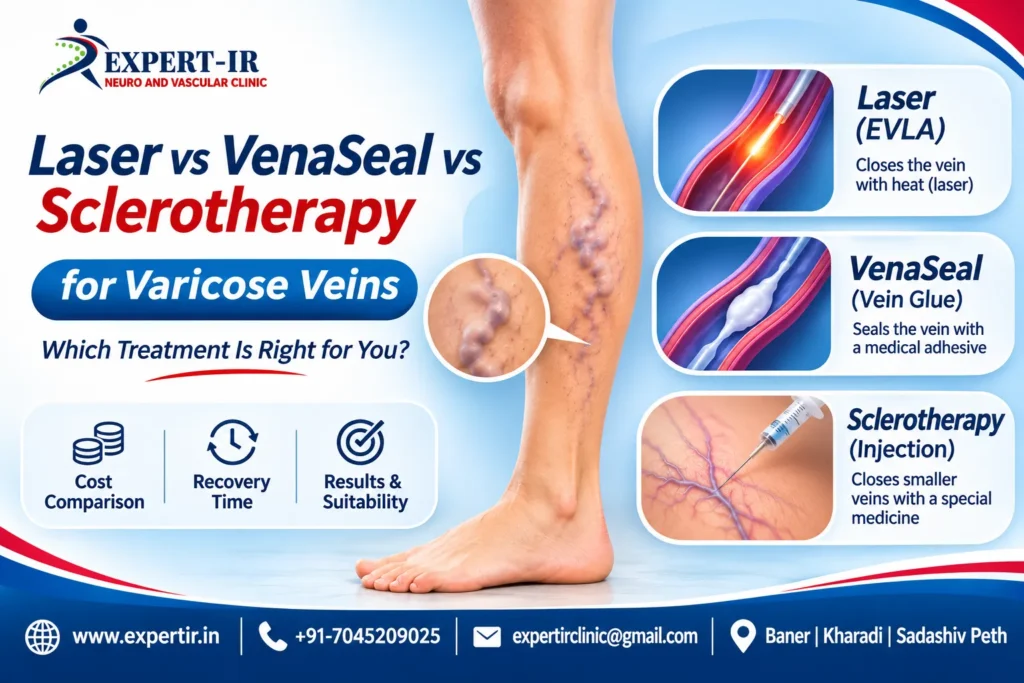
Laser vs VenaSeal vs Sclerotherapy for Varicose Veins | Cost, Recovery
Once people decide to treat their varicose veins, the next question comes quickly. “Doctor, which treatment is best? Laser, glue or injection?”
It is a fair question, because all three are non-surgical, all three are done as day-care procedures, and all three promise quick recovery. Yet each one is built for a different job.
Think of your leg veins as a tree. The main trunk is the large saphenous vein that runs along the leg, and the branches are the smaller veins that bulge on the surface. If the trunk is leaking, treating only the branches is like trimming leaves while the root problem keeps growing. That is why the right treatment always starts with finding where the leak is.
In this article, we compare Laser vs VenaSeal vs Sclerotherapy side by side, covering how they work, cost, recovery, results and who each one is best for.
Quick Answer
Laser, VenaSeal and sclerotherapy are all non-surgical treatments for varicose veins, but they work on different kinds of veins.
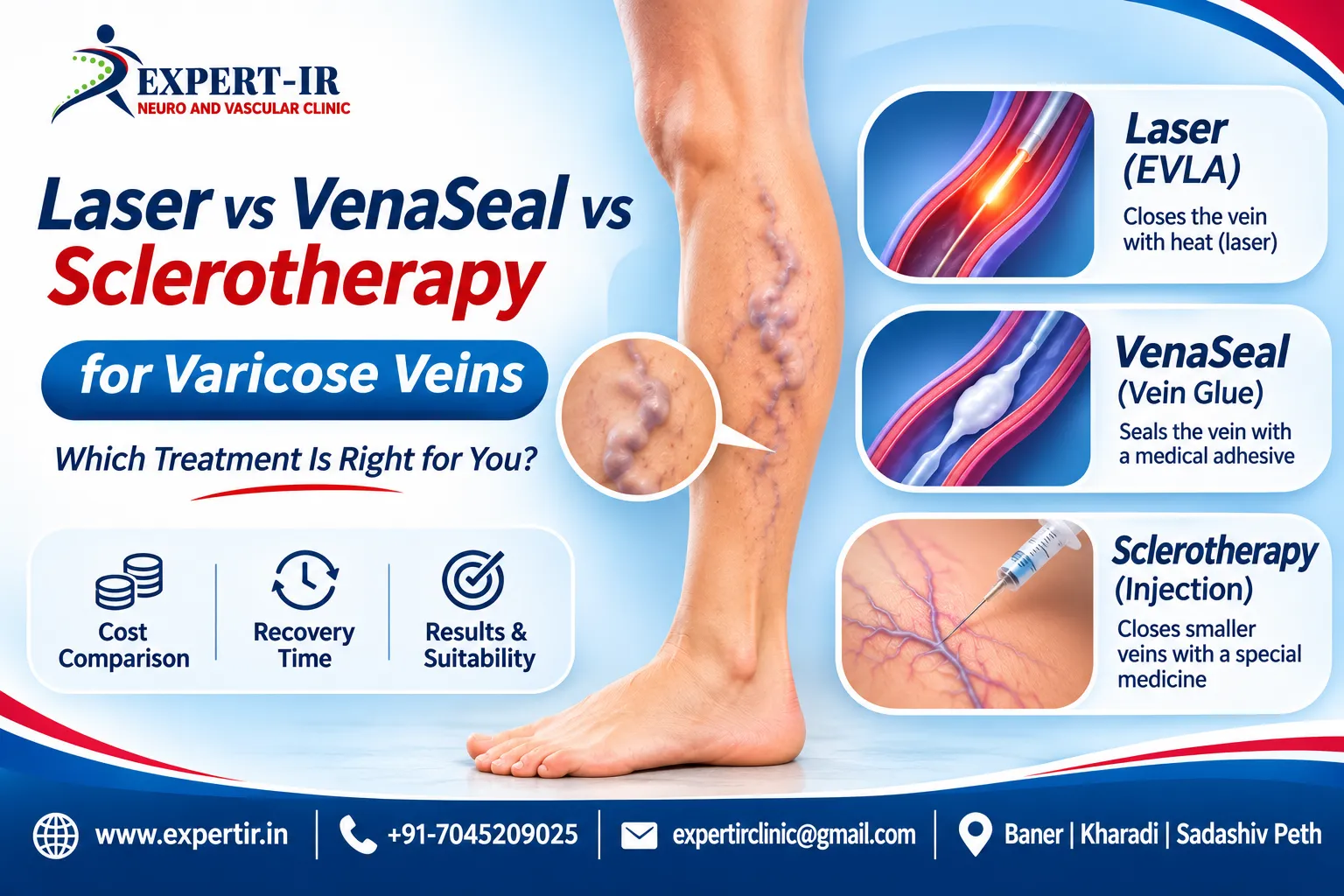
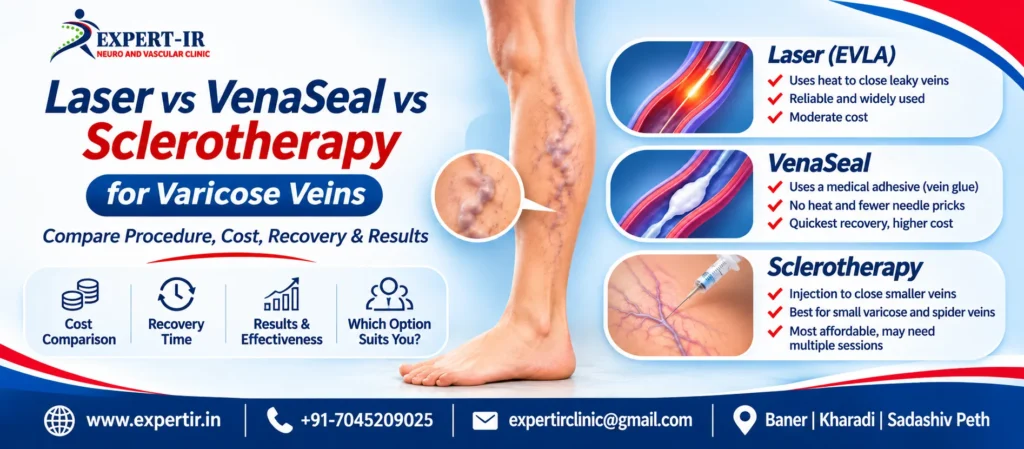
- Laser (EVLA): Uses heat from inside the vein to close large, leaky main veins. Reliable, widely used and moderately priced
- VenaSeal: Uses a medical adhesive to seal large main veins, with no heat and very few needle pricks. Quickest recovery, but the highest cost
- Sclerotherapy: An injection that closes small varicose veins and spider veins. The most affordable, but may need more than one session
Indicative cost in India: Laser around ₹45,000 to ₹1.2 lakh per leg, VenaSeal around ₹1.5 lakh to ₹3 lakh per leg, and sclerotherapy around ₹15,000 to ₹40,000 per session.
The right choice depends on your Doppler scan, not on the price tag. Many patients get the best result from a combination, such as laser or VenaSeal for the main vein and sclerotherapy for the smaller branches.
Root Cause
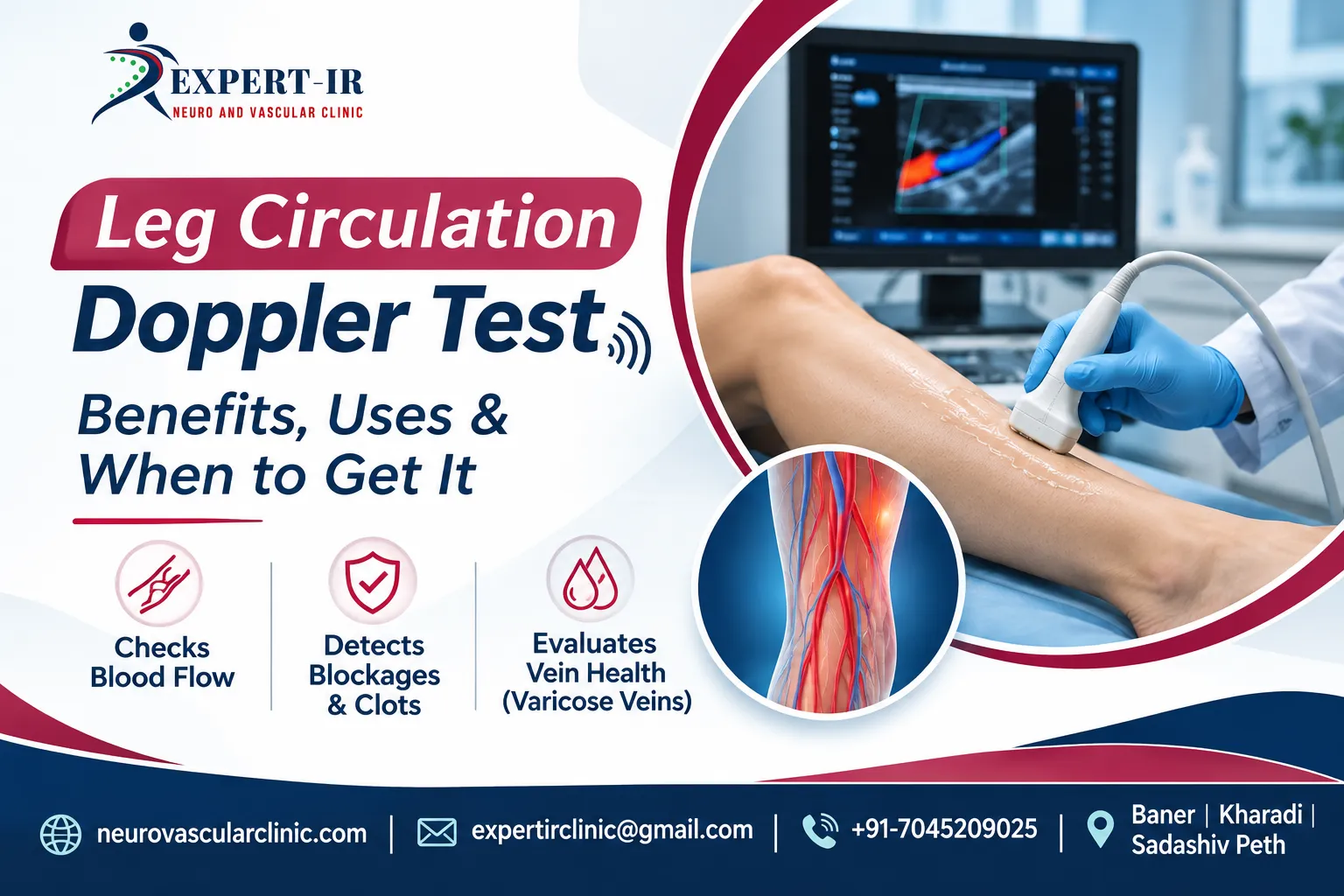
Before choosing any treatment, your doctor will advise a venous Doppler scan. This painless ultrasound shows:
- Which veins have leaky valves
- How long the faulty segment is
- Whether the main trunk vein is involved or only the smaller branches
- Whether there is any clot in the deep veins
This one test usually decides the treatment. Large, leaky main veins are treated with laser or VenaSeal. Small varicose veins and spider veins are treated with sclerotherapy.
What Is Laser Treatment (EVLA)?
Endovenous Laser Ablation (EVLA) closes the faulty vein using laser heat delivered from inside.
A thin laser fibre is passed into the vein through a needle prick under ultrasound guidance. Numbing fluid is injected around the vein along its length, and the laser gently heats and closes it as the fibre is slowly withdrawn. Blood then reroutes to healthy veins.
Best for: Large, straight main veins with reflux, such as the great or small saphenous vein.
What Is VenaSeal Treatment?
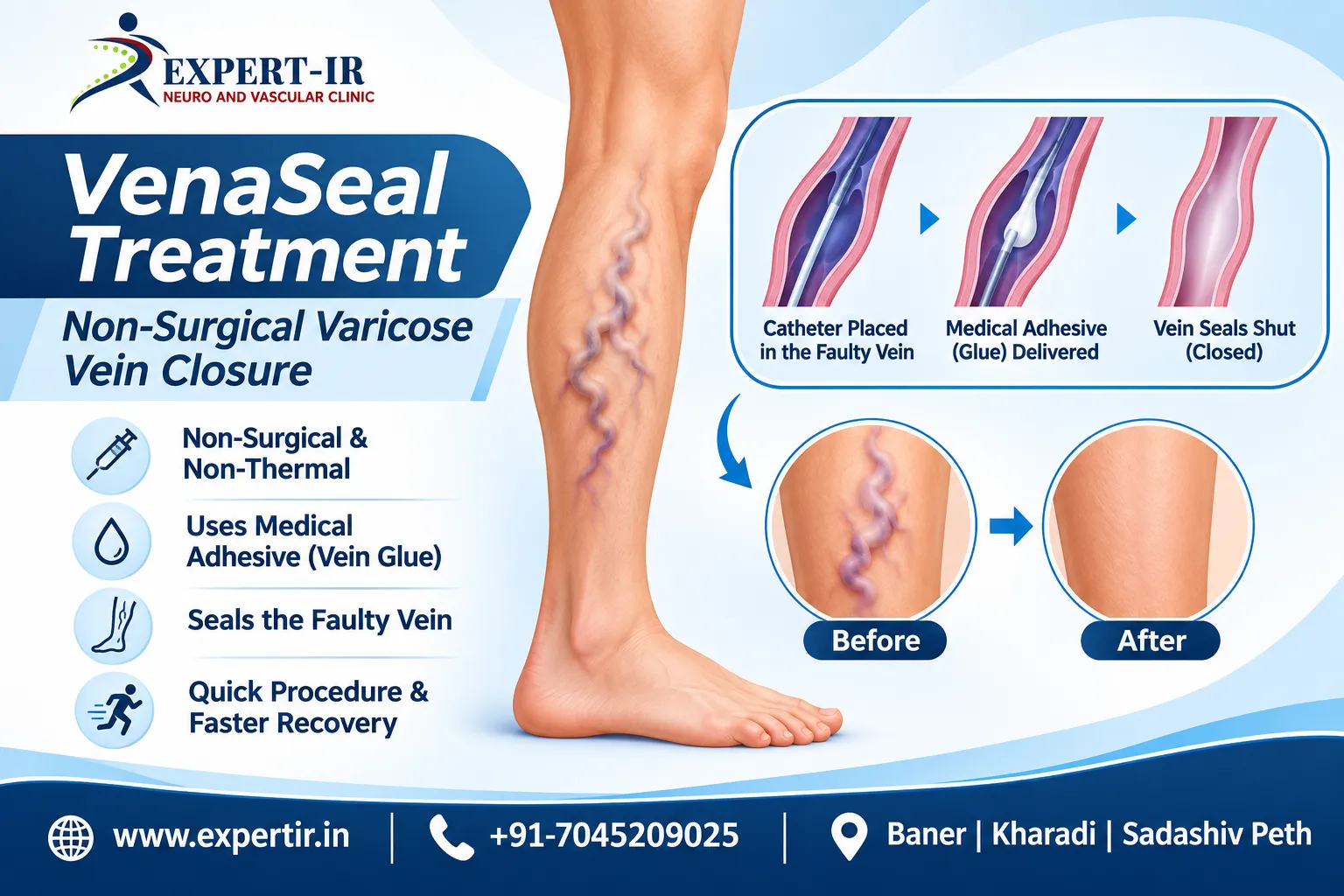
VenaSeal closes the faulty vein using a medical-grade adhesive instead of heat.
A thin catheter is placed in the vein through one needle prick. Small amounts of adhesive are released along the vein while it is gently pressed from outside, sealing it shut. Because no heat is used, there is no need for multiple numbing injections along the leg.
Best for: Large main veins, especially in patients who want minimal needle pricks, a very quick return to routine, or who may not suit thermal treatment.
What Is Sclerotherapy?
Sclerotherapy treats veins with an injection of a medicine called a sclerosant. The medicine irritates the inner lining of the vein, which makes it close and slowly fade away.
For spider veins, a liquid solution is used. For slightly larger varicose veins, the medicine is mixed into a foam, called foam sclerotherapy, often given under ultrasound guidance.
Best for: Spider veins, small to medium varicose veins, branch veins left after laser or VenaSeal, and some recurrent veins.
Laser vs VenaSeal vs Sclerotherapy
Factor | Laser (EVLA) | VenaSeal | Sclerotherapy |
How it works | Laser heat closes the vein | Medical adhesive seals the vein | Injected medicine closes the vein |
Best for | Large main veins | Large main veins | Spider veins and small to medium veins |
Heat used | Yes | No | No |
Anaesthesia | Local numbing along the vein | Local numbing at entry point only | Usually none |
Procedure time | About 30 to 60 minutes | About 30 to 60 minutes | About 15 to 30 minutes per session |
Sessions needed | Usually one | Usually one | Often more than one |
Return to routine | 1 to 2 days | Same day or next day | Same day |
Compression stockings | Usually advised | Often not needed | Usually advised |
Indicative cost in India | ₹45,000 to ₹1.2 lakh per leg | ₹1.5 lakh to ₹3 lakh per leg | ₹15,000 to ₹40,000 per session |
Costs are indicative and vary by hospital, city and the number of veins treated. Your exact estimate is shared after your Doppler and consultation.
Cost Comparison
Laser (EVLA)
Laser offers strong, long-lasting results at a moderate cost, which is why it is one of the most widely used treatments for large varicose veins. The cost rises if both legs or several veins are treated.
VenaSeal
VenaSeal is the most expensive of the three, mainly because of the closure system itself. What you pay for is comfort: fewer needle pricks, no heat and the fastest return to routine.
Sclerotherapy
Sclerotherapy has the lowest cost per session. However, it may need two or more sessions, a few weeks apart, so the total cost depends on how many veins need treatment.
Recovery Comparison
Recovery after laser
- Walk out the same day
- Mild tightness, bruising or tenderness along the treated vein for a few days
- Back to routine activities in about 1 to 2 days
- Compression stockings are usually advised for a short period
Recovery after VenaSeal
- Walk out within an hour or so
- Back to routine activities the same day or the next day
- Minimal bruising for most patients
- Compression stockings are often not needed, though your doctor will guide you
Recovery after sclerotherapy
- Walk out right after the session
- Normal routine the same day
- Treated veins fade gradually over weeks, so results are not instant
- Compression stockings and walking are usually advised after each session
Results and Durability
- Laser and VenaSeal both show high, long-lasting closure rates for large main veins. In a US study, VenaSeal and radiofrequency ablation showed similar closure at 3 years
- Sclerotherapy works very well for spider veins and smaller varicose veins, but larger veins may need repeat sessions
- No treatment stops new veins forever. Vein disease can progress, so new varicose veins may appear over the years. Staying active and attending follow-ups help
Possible Side Effects
Treatment | Common Side Effects |
Laser | Bruising, tightness, temporary skin numbness or tingling along the vein, rarely skin burns or nerve irritation |
VenaSeal | Phlebitis-like redness or itching over the vein, mild bruising, allergic reaction to the adhesive in a few people |
Sclerotherapy | Temporary bruising, brownish skin staining, small new red veins (matting), mild discomfort at injection sites |
In all three, a clot extending into a deep vein is rare, and it is checked for on follow-up Doppler.
Which Treatment Is Right for You?
Laser may suit you if:
- Doppler shows a large, leaky main vein
- You want a proven, reliable option at moderate cost
- You do not mind a short recovery of a day or two
VenaSeal may suit you if:
- Doppler shows a large, leaky main vein
- You want the fewest needle pricks and no heat
- You need to get back to work almost immediately
- You have no allergy to adhesives or acrylates
Sclerotherapy may suit you if:
- You have spider veins or small varicose veins
- The main trunk vein is healthy
- You have leftover branch veins after laser or VenaSeal
- You prefer the lowest cost per session
Often, the best answer is a combination. For example, the main vein is closed with laser or VenaSeal, and the remaining surface branches are cleared with sclerotherapy.
Why Choose Expert IR for VenaSeal Treatment in Pune?
At Expert IR Neuro & Vascular Clinic, Dr. Santosh Patil, a Neuro and Vascular Interventional Radiologist and European Board-Certified vascular specialist who offers laser, VenaSeal, RFA and sclerotherapy under one roof, so your treatment is chosen for your veins, not limited by what is available.
- Doppler-guided evaluation to find the root cause
- All major non-surgical vein treatments in one place
- Honest guidance on the option that fits your veins and budget
- Transparent estimates before treatment
- Three convenient locations in Pune: Baner (Manipal Hospital), Kharadi (Manipal Hospital) and Sadashiv Peth (Apollo Spectra)
Choose the right treatment that fits your veins
Laser, VenaSeal and sclerotherapy are all excellent treatments when used for the right vein. The best way to choose is not by comparing price lists, but by understanding exactly what is happening inside your legs.
If heavy, aching or visible veins are troubling you, book a vein consultation at Expert IR Clinic. A simple Doppler scan will show which treatment, or which combination, will work best for you.
Book an appointment: +91-7045209025
Frequently Asked Questions (FAQs)
There is no single best treatment for everyone. Laser and VenaSeal are best for large, leaky main veins, while sclerotherapy is best for spider veins and small varicose veins. A venous Doppler scan shows which treatment, or combination, will work best for your veins.
Laser treatment for varicose veins in India costs around ₹45,000 to ₹1.2 lakh per leg. VenaSeal costs around ₹1.5 lakh to ₹3 lakh per leg. Sclerotherapy costs around ₹15,000 to ₹40,000 per session. Final costs depend on the number of veins treated and the hospital.
VenaSeal and sclerotherapy usually have the fastest recovery, with most people returning to routine the same day. Laser recovery is also quick, usually 1 to 2 days, with some mild tightness or bruising along the treated vein.
VenaSeal and laser give similar results for large main veins. VenaSeal uses no heat and needs fewer needle pricks, which can mean less discomfort and a faster return to work. Laser is more affordable. The better choice depends on your veins, health and budget.
Sclerotherapy works best for spider veins and small to medium varicose veins. Large main veins with leaky valves are usually better treated with laser or VenaSeal, while foam sclerotherapy can be used for some larger branch veins.
Laser treatment is done under local anaesthesia, so it is not usually painful. You may feel mild pressure or a few needle pricks while the numbing is given. After the procedure, some tightness or tenderness along the vein is common for a few days.
Many patients need two or more sessions of sclerotherapy, spaced a few weeks apart. The number depends on the size and number of veins being treated.
Compression stockings are usually advised after laser and sclerotherapy for a short period. After VenaSeal, many patients may not need them, although your doctor may still recommend them based on your case.