Peripheral Angioplasty Cost in Pune | Price & Factors
When a doctor says the word “angioplasty”, the first question in most families is not “how is it done?” but “how much will it cost?” That is completely natural.
The honest answer is that there is no single fixed price. Peripheral angioplasty is planned around your own arteries, and two patients with the same leg pain can need very different treatment. One may need a single balloon in the thigh artery. Another may need work on three levels, from the hip down to the ankle.
In this article, we break down the cost of peripheral angioplasty in Pune, what pushes the price up or down, what is usually included, and how to plan for it without stress.
Quick Summary
Peripheral angioplasty cost in Pune usually falls in a broad range of about ₹1 lakh to ₹4 lakh or more. The final amount depends on how many arteries are blocked, whether a stent or drug-coated balloon is needed, the hospital category and the length of stay. A simple balloon angioplasty sits at the lower end, while long or multi-level blockages, special devices and treatment for non-healing wounds cost more.
- Biggest cost drivers: Number and length of blockages, type of balloon or stent, hospital category
- Usually included: Procedure, cath lab, devices, hospital stay and routine medicines (confirm the package details)
- Often extra: Pre-procedure scans, extra stents or devices, longer stay, wound care
- Insurance: Most health insurance policies cover medically needed angioplasty, subject to policy terms
- Exact cost: Known only after your scans show the location and length of the blockage
What Is Peripheral Angioplasty?
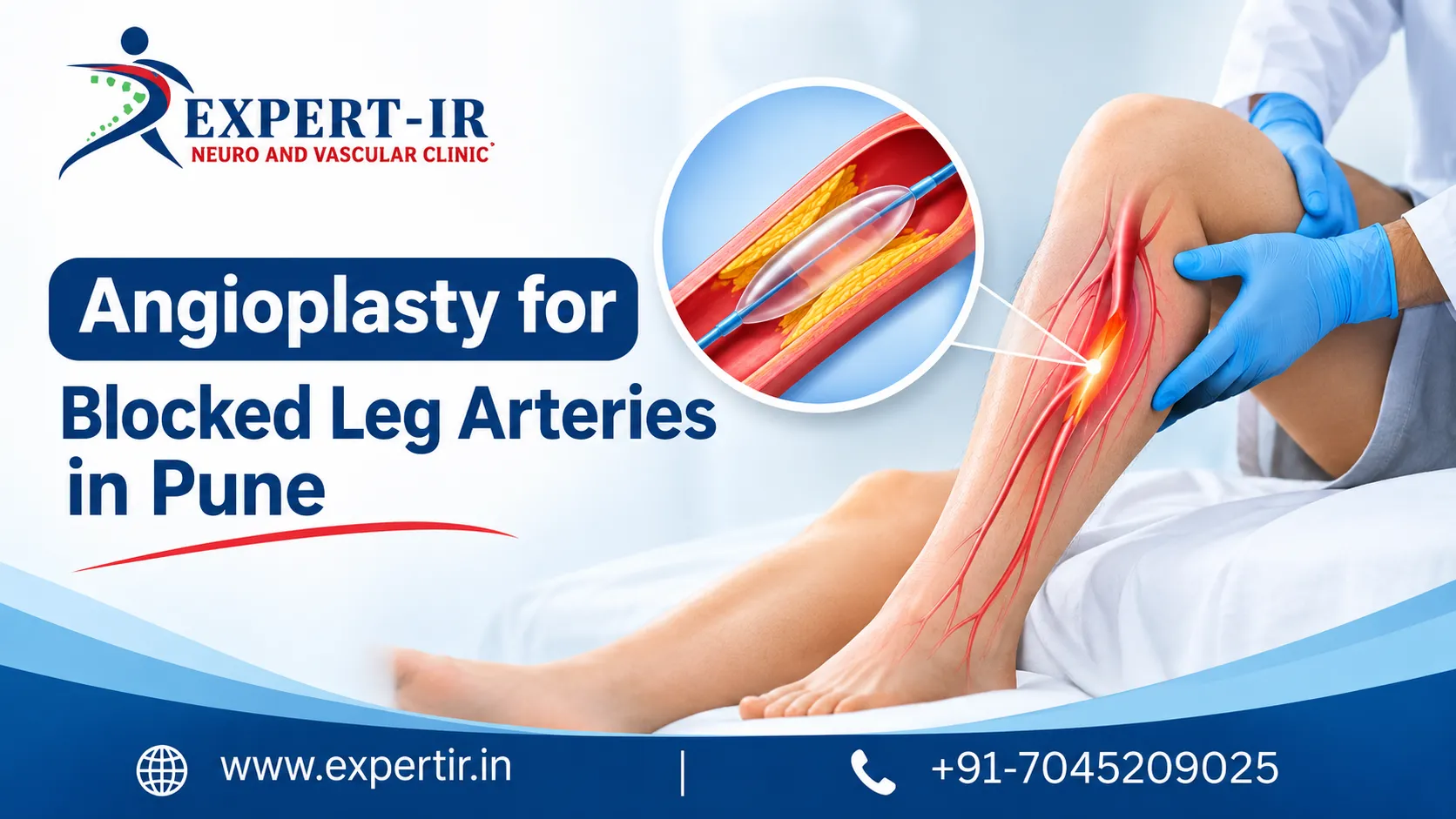
Peripheral angioplasty is a minimally invasive procedure that opens blocked or narrowed arteries outside the heart, most commonly in the legs. It treats Peripheral Artery Disease (PAD), where plaque narrows the arteries and reduces blood flow to the legs and feet.
Through a pinhole puncture, usually in the groin, a thin wire and balloon are guided to the blockage under X-ray. The balloon widens the artery, and a stent may be placed to keep it open. It is done under local anaesthesia, and most patients walk within hours.
For a full walkthrough of the procedure and recovery, read our article on Angioplasty for Blocked Leg Arteries in Pune.
Peripheral Angioplasty Cost in Pune

The table below gives a general picture. These are indicative ranges only, and the final estimate is shared after your evaluation.
Procedure Type | Indicative Cost in Pune |
Peripheral angiography (diagnostic only) | Around ₹18,000 to ₹25,000 |
Plain balloon angioplasty (single, short blockage) | Around ₹1 lakh to ₹1.5 lakh |
Angioplasty with drug-coated balloon | Around ₹1.5 lakh to ₹2.5 lakh |
Angioplasty with stent | Around ₹1.5 lakh to ₹3 lakh |
Complex or multi-level angioplasty (long blockages, below-knee arteries, multiple devices) | ₹3 lakh to ₹4 lakh or more |
Costs vary by hospital, devices used and the patient’s condition. Please treat these figures as a guide, not a quote.
What Affects the Cost of Peripheral Angioplasty?
1. Location and length of the blockage
A short narrowing in the thigh artery is quicker and simpler to treat. Long blockages, or arteries below the knee, need more time, more wires and often more devices.
2. Number of arteries treated
Treating one artery costs less than treating two or three levels in the same leg, or both legs.
3. Balloon or stent type
- Plain balloon: Most affordable option
- Drug-coated balloon: Releases medicine that helps reduce re-narrowing, so it costs more
- Bare-metal stent: Keeps the artery open, with moderate cost
- Drug-eluting stent: Costs more, used for selected blockages
4. Hard or calcified arteries
Heavily calcified arteries, common in long-standing diabetes and kidney disease, may need special devices to prepare the vessel. This adds to the cost.
5. Hospital category and room type
Costs differ between multi-speciality and super-speciality hospitals, and between general ward, sharing room and private room.
6. Length of hospital stay
Many patients go home the same day or the next morning. Patients with foot wounds, infection or other health conditions may need a longer stay.
7. Your overall health
Diabetes, kidney function, heart health and infections may need extra tests, medicines or monitoring before and after the procedure.
8. Wound care and follow-up
If angioplasty is done to heal a foot ulcer or gangrene, dressing, minor wound procedures and repeat visits add to the overall treatment cost.
Does Insurance Cover Peripheral Angioplasty?
In most cases, yes. Peripheral angioplasty is a medically needed procedure for PAD, and most health insurance policies cover it, subject to the terms of your policy.
Before the procedure, check:
- Whether the hospital is in your insurer’s cashless network
- Waiting periods for existing conditions like diabetes or high blood pressure
- Room rent limits, which can affect the final claim
- Co-payment or sub-limits on stents and devices
- Documents needed for pre-authorisation
Our team can help guide you through the paperwork for cashless or reimbursement claims.
Is Angioplasty Worth the Cost?
It helps to look at what the treatment protects. Untreated PAD can slowly take away walking distance, cause pain at rest and, in severe cases, lead to non-healing wounds and gangrene. At that stage, treatment becomes more complex, longer and more expensive.
Compared with open bypass surgery, angioplasty usually means:
- No large incision, only a pinhole puncture
- Local anaesthesia in most cases
- Shorter hospital stay, often same day or overnight
- Faster return to work and daily life
- Lower risk of wound complications
For many patients, timely angioplasty is not just a cost. It is an investment in staying independent and on their feet.
How to Plan Your Angioplasty Cost
- Get a proper evaluation first: A Doppler or CT angiography shows exactly what needs to be done, which makes the estimate accurate
- Ask for a written package estimate: With inclusions and exclusions clearly listed
- Discuss device options: Ask why a stent or drug-coated balloon is advised for your blockage
- Check insurance early: Start pre-authorisation before the admission date
- Do not delay treatment for long: Early treatment is usually simpler and more affordable
Why Choose Expert IR Neuro & Vascular Clinic for Peripheral Angioplasty in Pune?
At Expert IR Clinic, Dr. Santosh Patil, a Neuro and Vascular Interventional Radiologist and European Board-Certified specialist, treats blocked leg arteries from the inside, without open surgery wherever possible.
- Clear, transparent estimates after a complete evaluation
- Treatment planned around the root cause, not just the symptoms
- Right device for the right blockage, so you do not pay for what you do not need
- Expertise in complex and below-knee blockages, including diabetic foot cases
- Three convenient locations in Pune: Baner (Manipal Hospital), Kharadi (Manipal Hospital) and Sadashiv Peth (Apollo Spectra)
Get an Accurate Cost Estimate
The only way to know your exact angioplasty cost is to know your arteries. If you or a loved one has leg pain while walking, cold or numb feet, or a foot wound that is slow to heal, book a vascular evaluation at Expert IR. You will get a clear treatment plan and a transparent estimate before any decision is made.
Book an appointment: +91-7045209025
Frequently Asked Questions (FAQs)
Peripheral angioplasty in Pune usually costs between about ₹1 lakh and ₹4 lakh or more. The final cost depends on the number and length of blockages, whether a stent or drug-coated balloon is used, the hospital category and the length of stay.
Leg angioplasty with a stent in Pune generally costs around ₹1.5 lakh to ₹3 lakh. Drug-eluting stents, multiple stents or complex blockages can increase the cost further.
The cost varies because every patient’s blockage is different. Location, length, calcium build-up, number of arteries treated, devices used, hospital stay and overall health all affect the final amount.
Yes. Plain balloon angioplasty is usually the most affordable option because no stent is placed. Your doctor decides between a balloon, drug-coated balloon or stent based on what will keep your artery open best.
Most health insurance policies cover peripheral angioplasty when it is medically needed. Coverage depends on your policy terms, waiting periods, room rent limits and whether the hospital is in the cashless network.
Common tests include an Ankle-Brachial Index (ABI), arterial Doppler, CT angiography and blood tests. These are often charged separately from the angioplasty package, so ask whether they are included.
In many cases, yes. Angioplasty usually needs a shorter hospital stay, local anaesthesia and a faster recovery, which can lower the overall cost compared with open bypass surgery. The right choice depends on your blockage.
Most patients go home the same day or the next morning. A longer stay may be needed for patients with foot wounds, infection, kidney problems or other health conditions, which can add to the cost.