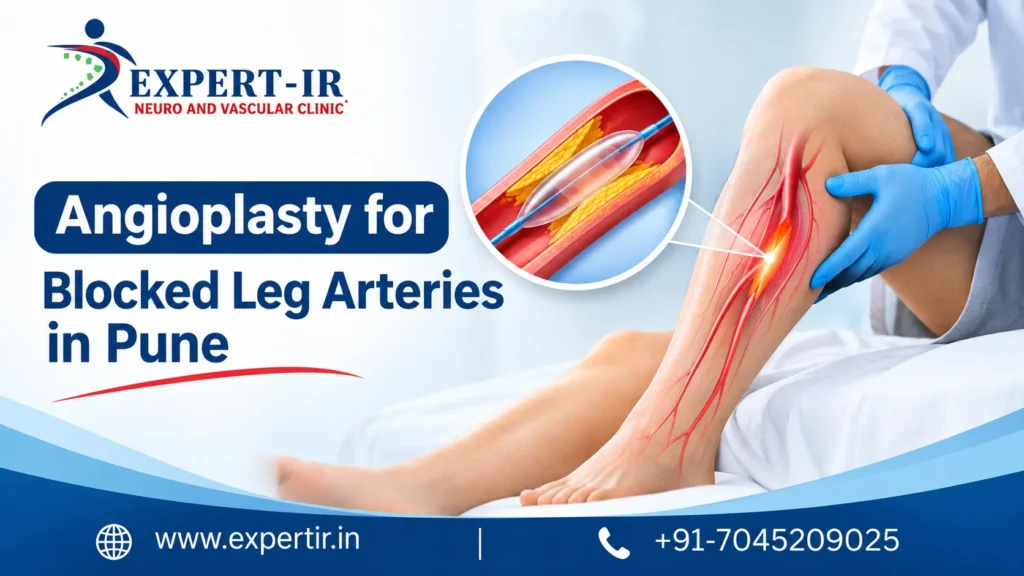
Angioplasty for Blocked Leg Arteries in Pune | Procedure & Recovery
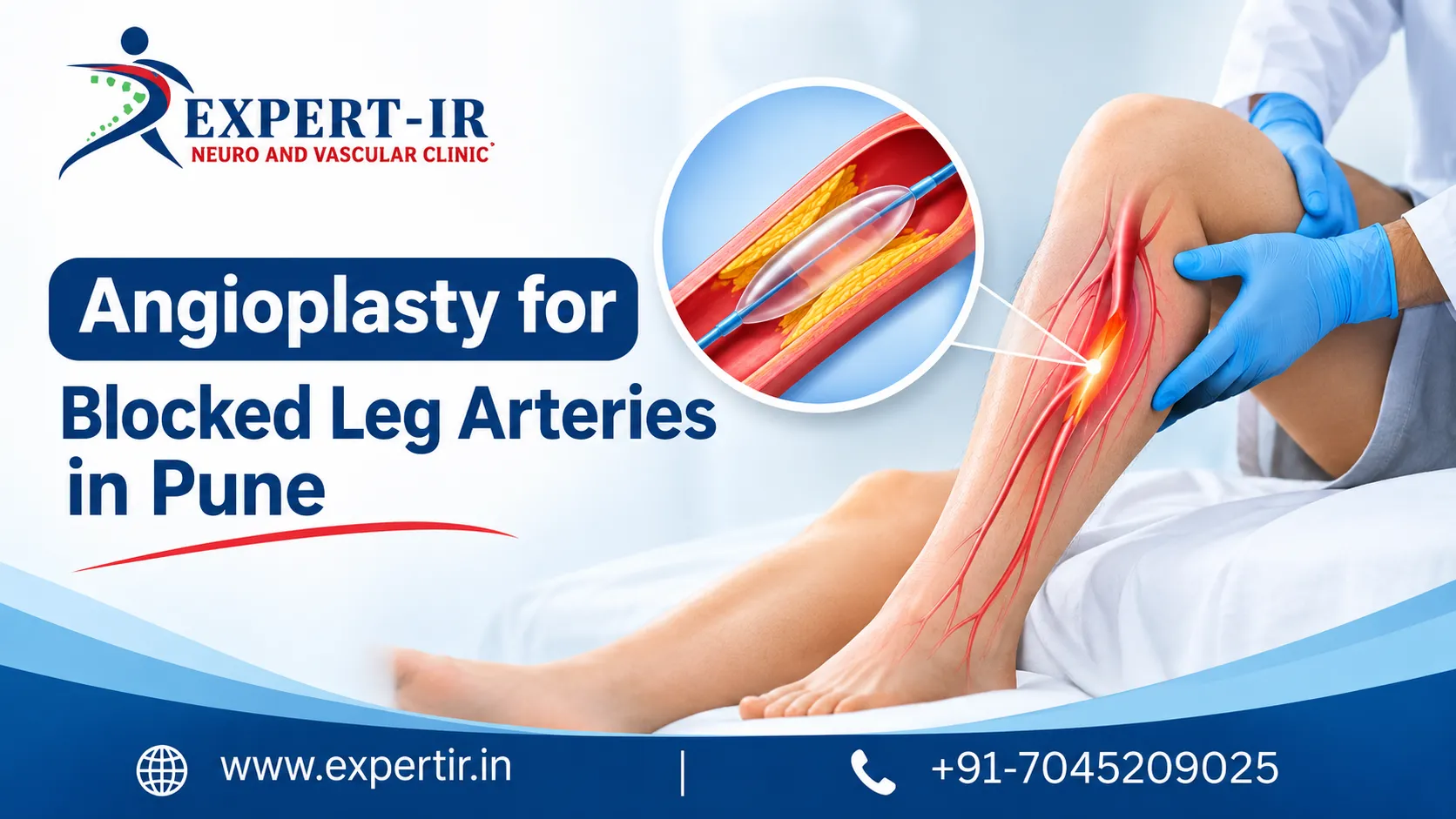
Angioplasty for blocked leg arteries is a minimally invasive procedure that opens a narrowed or blocked artery in the leg using a tiny balloon, and sometimes a stent, passed through a pinhole in the skin. It is done under local anaesthesia, usually takes 1 to 2 hours, and most patients walk the same day or the next morning. It is used to treat Peripheral Artery Disease (PAD) when leg pain while walking, pain at rest, or non-healing foot wounds signal that blood flow to the leg is reduced.
- Who needs it: People with PAD whose leg pain limits daily life, or who have rest pain, foot ulcers or early gangrene
- How it is done: Through a needle puncture, usually in the groin, with X-ray guidance
- Hospital stay: Same day or overnight in most cases
- Recovery: Light activity in 2 to 3 days, most routine activities within about a week
- No big cuts, no stitches, no general anaesthesia in most cases
When Walking Becomes Painful
It often starts quietly. A cramp in the calf while walking to the market. A pause halfway up the stairs. The pain eases after a minute of rest, so it gets blamed on age, weak muscles or a long day.
But when this pattern repeats, walk, pain, rest, relief, the cause is often not the muscle at all. It can be a blocked artery in the leg, a condition called Peripheral Artery Disease (PAD).
The good news is that many blocked leg arteries today can be opened without open surgery. Angioplasty is one of the most effective ways to do this, and for many patients in Pune it means walking in with a painful leg and walking out with restored blood flow, often within a day.
In this guide, we explain what leg angioplasty is, who needs it, how the procedure works step by step, and what recovery really looks like.
What Are Blocked Leg Arteries?
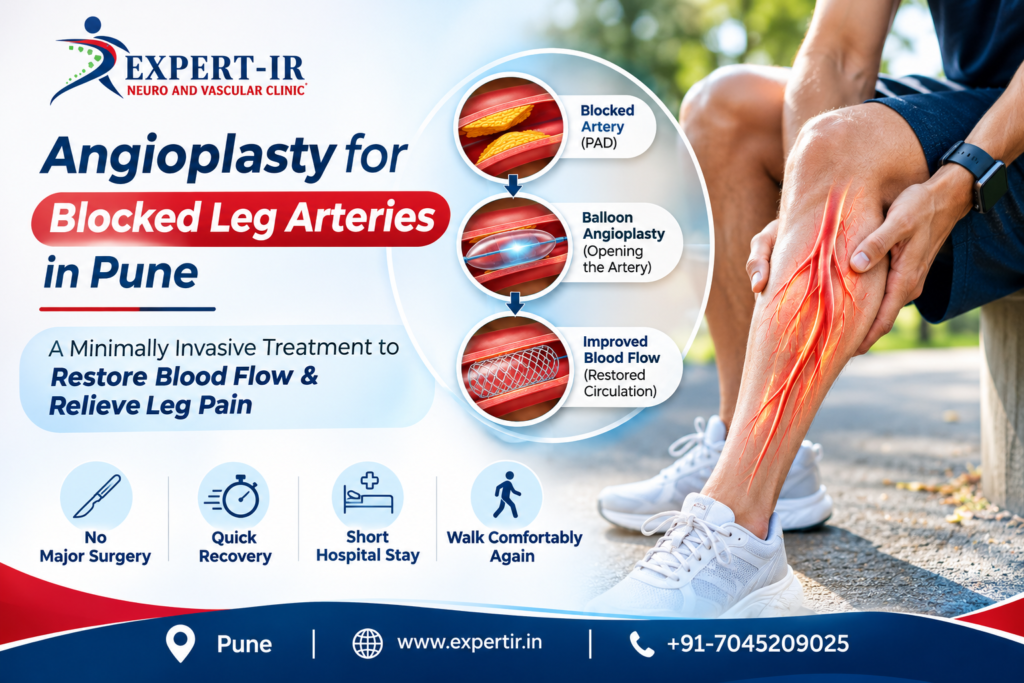
Arteries carry oxygen-rich blood from the heart to the legs and feet. Over the years, fat, cholesterol and calcium can build up inside the artery wall. This build-up, called plaque, slowly narrows the artery, the way rust narrows an old water pipe.
When the leg muscles do not get enough blood, especially during walking, they signal distress through pain. This is PAD.
Common risk factors
- Diabetes
- Smoking or tobacco use
- High blood pressure
- High cholesterol
- Age above 50
- Kidney disease
- Family history of heart or vascular disease
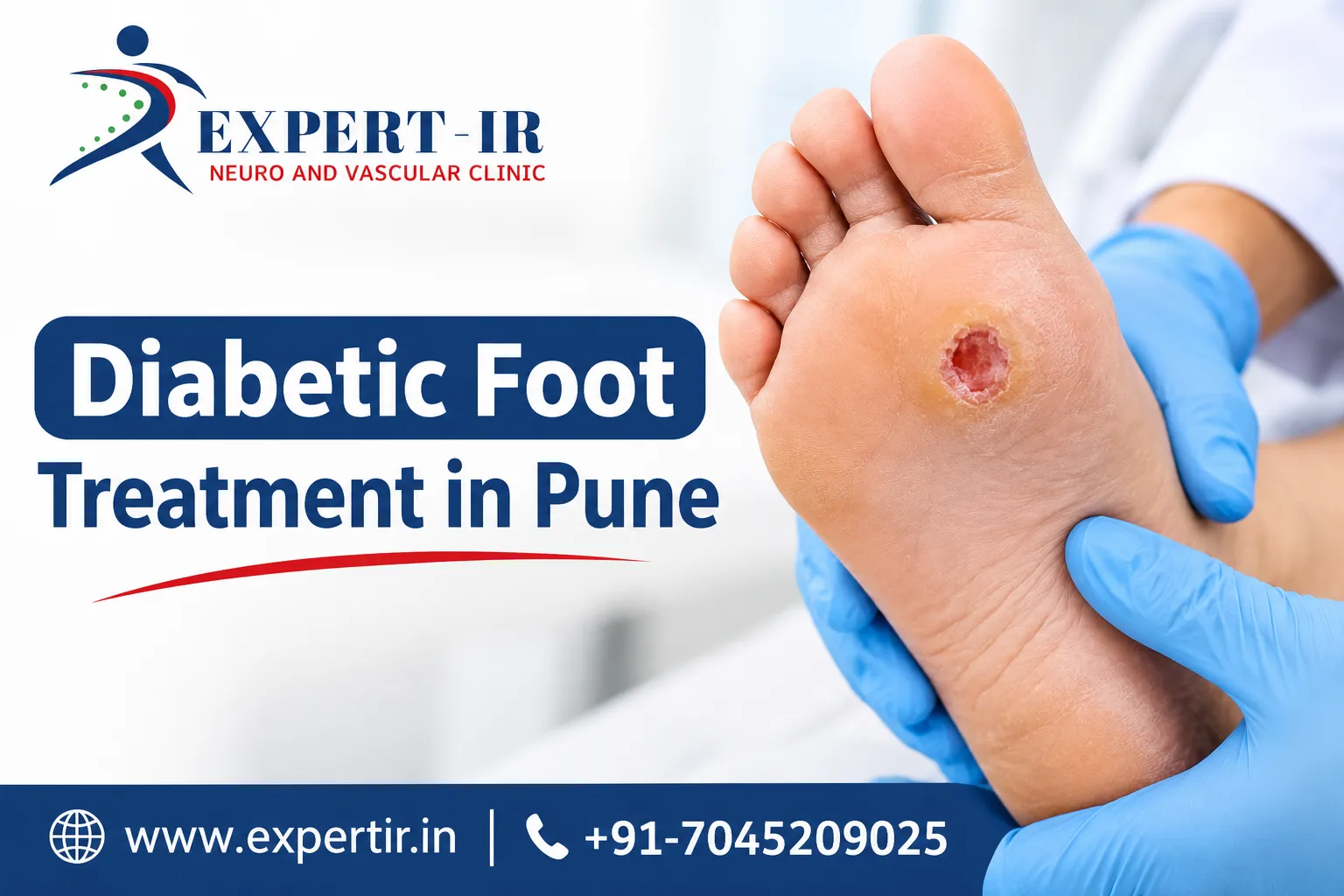
People with diabetes need extra attention, because PAD in diabetes can progress silently and show up first as a foot wound that refuses to heal.
Signs You May Need Angioplasty
Not everyone with PAD needs angioplasty right away. Many early cases improve with medicines, walking exercise and quitting smoking. Angioplasty is usually advised when symptoms affect daily life or the leg is at risk.
Warning signs
- Claudication: Pain, cramping or tiredness in the calf, thigh or hip while walking, which settles with rest
- Shorter walking distance over time
- Rest pain: Burning or aching in the foot or toes at night, often eased by hanging the leg off the bed
- Wounds or ulcers on the feet or toes that do not heal
- Cold, pale or bluish foot compared to the other side
- Weak or absent pulse in the foot
- Shiny skin, hair loss on the leg or slow toenail growth
- Blackening of a toe (gangrene)
Rest pain, non-healing wounds and gangrene point to Critical Limb Ischemia (CLI), the most severe stage of PAD. This needs urgent evaluation, as timely treatment can help save the limb.
How Are Blocked Leg Arteries Diagnosed?
Before planning angioplasty, the exact location and length of the blockage need to be mapped. This usually involves:
- Clinical examination: Checking pulses, skin colour, temperature and wounds
- Ankle-Brachial Index (ABI): A simple, painless test comparing blood pressure in the ankle and arm
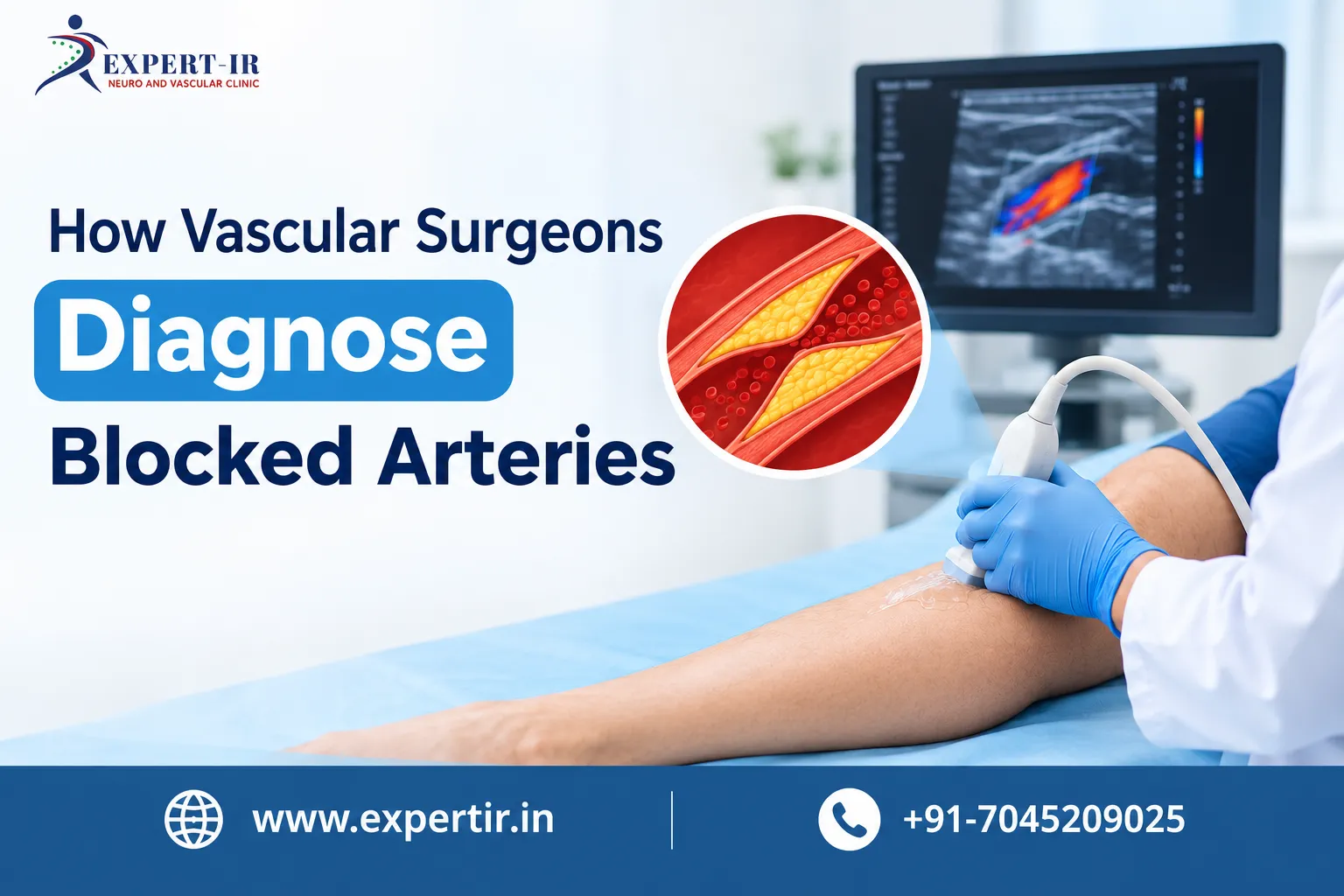
- Arterial Doppler ultrasound: Shows blood flow and pinpoints narrowed segments
- CT angiography or MR angiography: Gives a detailed road map of the arteries for planning
- Blood tests: Kidney function, sugar levels and clotting profile
This road map helps the interventional radiologist decide whether angioplasty alone, angioplasty with a stent, or another approach is best for you.
What Is Angioplasty for Blocked Leg Arteries?
Peripheral angioplasty (also called percutaneous transluminal angioplasty or PTA) is a procedure that opens a narrowed or blocked leg artery from the inside.
Instead of cutting open the leg, the doctor reaches the blockage through a tiny puncture in the skin, guides a thin tube to the narrowed spot using live X-ray imaging, and inflates a small balloon to push the plaque against the artery wall. Blood flow is restored almost immediately.
Types of leg angioplasty
Type
What It Does
When It Is Used
Balloon angioplasty
A balloon widens the narrowed artery
Short, simple narrowings
Drug-coated balloon angioplasty
The balloon releases medicine that helps reduce re-narrowing
Arteries at higher risk of re-blocking
Angioplasty with stent
A small metal mesh tube keeps the artery open
When the artery recoils or the blockage is complex
Drug-eluting stent
A stent coated with medicine to reduce re-narrowing
Selected blockages, based on location and length
The choice depends on where the blockage is (thigh, knee or below-knee arteries), how long it is, how hard or calcified it is, and the patient’s overall health.
Angioplasty Procedure
Knowing what happens on the day can take away much of the worry. Here is what a typical leg angioplasty looks like.
Before the procedure
- Your doctor reviews your scans, medicines and kidney function
- You may be asked to fast for 4 to 6 hours
- Blood thinners and diabetes medicines may be adjusted as advised
- Tell your doctor about any allergy, especially to contrast dye or iodine
During the procedure
- Local anaesthesia: The puncture area, usually the groin, is numbed. You stay awake, with mild sedation if needed
- Access: A needle puncture is made in the artery and a thin sheath is placed
- Mapping: Contrast dye is injected and X-ray images show the exact blockage
- Crossing the blockage: A fine guidewire is passed through the narrowed or blocked segment
- Opening the artery: A balloon is inflated to widen the artery. A stent may be placed if needed
- Checking the result: Final images confirm that blood is flowing freely to the foot
- Closing: The sheath is removed and the puncture is sealed with pressure or a closure device
The procedure usually takes 1 to 2 hours, depending on how complex the blockage is. Most patients feel only mild pressure, not pain.
Right after the procedure
- You rest in bed for a few hours, keeping the leg straight
- The puncture site and foot pulses are checked regularly
- Most patients go home the same day or the next morning
Benefits of Leg Angioplasty
- No open surgery: Just a pinhole puncture, no long incision
- Local anaesthesia: Safer for elderly patients and those with heart or lung problems
- Quick recovery: Most people are up and walking within hours
- Short hospital stay: Often same-day or overnight
- Pain relief: Walking distance and leg pain often improve soon after
- Better wound healing: Restored blood flow helps foot ulcers heal
- Limb salvage: In critical limb ischemia, timely angioplasty can help prevent amputation
- Can be repeated if the artery narrows again in the future
Angioplasty Recovery: What to Expect
Recovery after leg angioplasty is usually smooth and quick. Here is a simple timeline.
Time After Procedure | What to Expect |
First few hours | Bed rest with leg straight, puncture site monitored |
Day 1 | Short walks at home, mild soreness or bruising at puncture site is normal |
Days 2 to 3 | Light daily activities, avoid lifting heavy weights |
Within about 1 week | Most routine activities and desk work |
2 to 4 weeks | Gradual return to longer walks and exercise, as advised |
Follow-up | Doppler scan to check the artery stays open |
Patients treated for non-healing wounds may need ongoing wound care, and healing time depends on the size and depth of the wound.
Recovery tips
- Take your medicines regularly: Antiplatelet medicines help keep the artery open. Never stop them without your doctor’s advice
- Walk every day: Supervised walking improves circulation and stamina
- Quit smoking completely: Smoking is one of the biggest reasons arteries block again
- Control sugar, BP and cholesterol: These protect the treated artery and the others too
- Care for your feet: Check daily for cuts, blisters or colour changes, especially if you have diabetes
- Keep follow-up appointments: Regular scans catch re-narrowing early
When to call your doctor
- Bleeding or swelling at the puncture site that keeps increasing
- Sudden pain, coldness, numbness or colour change in the leg
- Fever or redness at the puncture site
- Return of leg pain while walking
Is Leg Angioplasty Safe?
Leg angioplasty is a well-established and generally safe procedure when performed by an experienced specialist. As with any procedure, there are some possible risks:
- Bruising or bleeding at the puncture site
- Reaction to contrast dye
- Effect on kidney function in people with existing kidney disease
- Injury to the artery, which is rare
- Re-narrowing of the artery over time (restenosis)
Your doctor will review your health, kidney function and scans to plan the safest approach for you.
Angioplasty vs Bypass Surgery
Factor | Angioplasty | Bypass Surgery |
Approach | Pinhole puncture | Open surgery with incision |
Anaesthesia | Local, with mild sedation | Usually general or spinal |
Hospital stay | Same day or overnight | Several days |
Recovery | Days | Weeks |
Best suited for | Many short and moderate blockages, high-risk patients | Some very long or complex blockages |
Today, angioplasty is often the first option considered for many patients, and bypass is kept for cases where angioplasty is not suitable.
Why Choose Expert IR Neuro & Vascular Clinic for Leg Angioplasty in Pune?
At Expert IR, Dr. Santosh Patil, a Neuro and Vascular Interventional Radiologist and European Board Certified specialist, focuses on treating blocked arteries from the inside, without open surgery wherever possible.
- Root-cause approach: Complete evaluation of the blockage, not just symptom relief
- Minimally invasive expertise: Balloon angioplasty, drug-coated balloons and stenting for leg arteries, including below-knee vessels
- Diabetic foot and limb salvage focus: Restoring blood flow to help wounds heal
- Personalised follow-up: Regular Doppler checks and lifestyle guidance
- Three convenient locations in Pune: Baner (Manipal Hospital), Kharadi (Manipal Hospital) and Sadashiv Peth (Apollo Spectra)
Don’t Ignore That Leg Pain
Leg pain while walking is not just a sign of ageing. It can be your body’s early warning that blood is not reaching where it needs to go. The earlier a blocked artery is found, the simpler the treatment, and the better the chance of protecting your leg.
If you or a family member in Pune has calf pain while walking, a foot wound that is slow to heal, or cold and numb feet, book a vascular evaluation at Expert IR. A few simple tests can tell you whether angioplasty is the right step for you.
Book an appointment: +91-7045209025
Frequently Asked Questions (FAQs)
Angioplasty for blocked leg arteries is a minimally invasive procedure that opens a narrowed leg artery using a small balloon, and sometimes a stent, passed through a pinhole puncture. It restores blood flow to the leg and foot without open surgery and is commonly used to treat Peripheral Artery Disease (PAD).
Yes. Diabetes-related nerve damage can reduce sensation, so an ulcer may develop without causing much pain. A painless wound still needs medical assessment.
You may need leg angioplasty if you have leg pain while walking that limits daily life, foot pain at rest, non-healing foot wounds, or blackening of the toes. A vascular specialist confirms the need with tests like the Ankle-Brachial Index (ABI), Doppler ultrasound and CT angiography.
Leg angioplasty is usually not painful. It is done under local anaesthesia, so the puncture area is numb, and mild sedation can be given. Most patients feel only slight pressure during the procedure and mild soreness at the puncture site afterwards.
Leg angioplasty usually takes 1 to 2 hours. The exact time depends on how many arteries are blocked, how long the blockage is, and whether a stent is needed.
Most patients walk within hours and go home the same day or the next morning. Light activities can usually resume in 2 to 3 days and most routine activities within about a week. Recovery may take longer if foot wounds are being treated.
No, a stent is not always needed. Many blockages are treated with balloon angioplasty or drug-coated balloons alone. A stent is placed when the artery does not stay open after ballooning or when the blockage is complex.
Yes, the treated artery can narrow again over time, which is called restenosis. Taking prescribed medicines, quitting smoking, controlling diabetes, blood pressure and cholesterol, and attending regular Doppler follow-ups help reduce this risk. If needed, angioplasty can be repeated.