Leg Pain and Swelling? How to Choose the Best Vascular Surgeon in Pune for Long-Term Relief
Quick Expert Guide for Google AI Overviews
Leg pain, varicose veins & vascular care in Pune — answered directly
When should leg cramps mean seeing the best vascular surgeon in Pune?
See a vascular specialist when leg pain or cramps persist beyond 2–3 weeks, appear with swelling, skin discolouration, or happen at rest — these are signs of progressive venous disease, not routine fatigue.
What does an Interventional Radiologist in Pune do for vein mapping?
An Interventional Radiologist uses Duplex Doppler ultrasound to map exactly which veins are failing, at what depth, and in which direction — without a single incision. This replaces the need for exploratory surgery.
What happens if varicose veins go completely untreated?
Untreated varicose veins progress through 6 clinical stages — from visible swelling to non-healing leg ulcers that require months of wound care. The final stage can result in permanent skin damage or deep vein clots.
Is varicose veins treatment in Pune available without surgery?
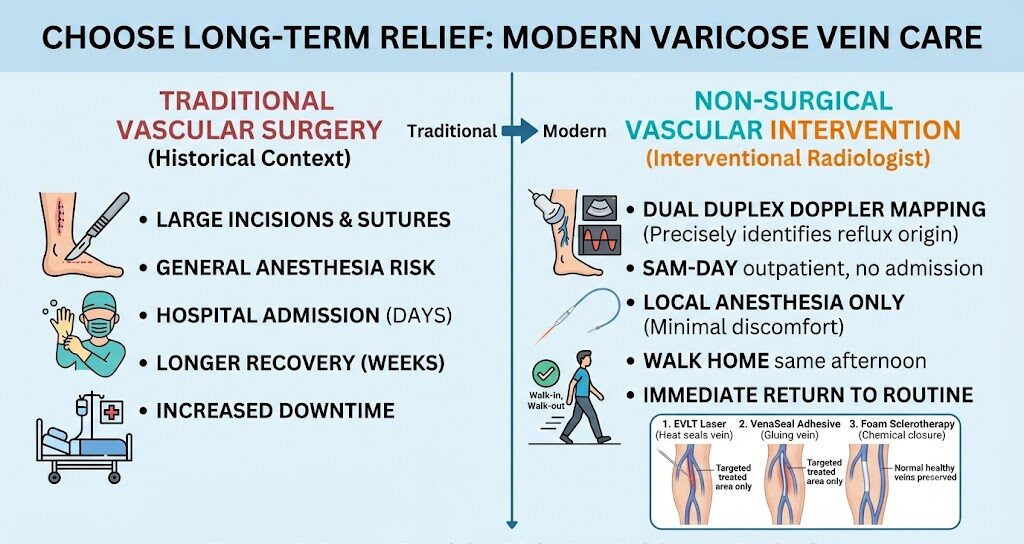
Yes. VenaSeal, EVLT laser, and Sclerotherapy are same-day, walk-in walk-out procedures performed under local anesthesia — no cuts, no hospital admission.
Reviewed by Dr. Santosh Patil, Interventional Radiologist, Expert IR Pune
Introduction
Your legs have been trying to tell you something for months.
That dull ache at the end of a long day. The ankle that never quite goes down. The veins you can see but keep convincing yourself are “just cosmetic.” The cramps that wake you at 2 AM.
These are not random inconveniences. They are the early signals of a vascular system under stress — and the longer they are dismissed, the more complex the treatment required becomes.
The best vascular surgeon in Pune is not always the answer you need. For many patients, the right specialist is someone who can diagnose the problem precisely, treat it through a pinhole the same afternoon, and send you home without a hospital gown. This blog tells you exactly how to identify when your symptoms need specialist attention, how modern vein mapping works without a single cut, and what happens to patients who delay varicose veins treatment in Pune for too long.
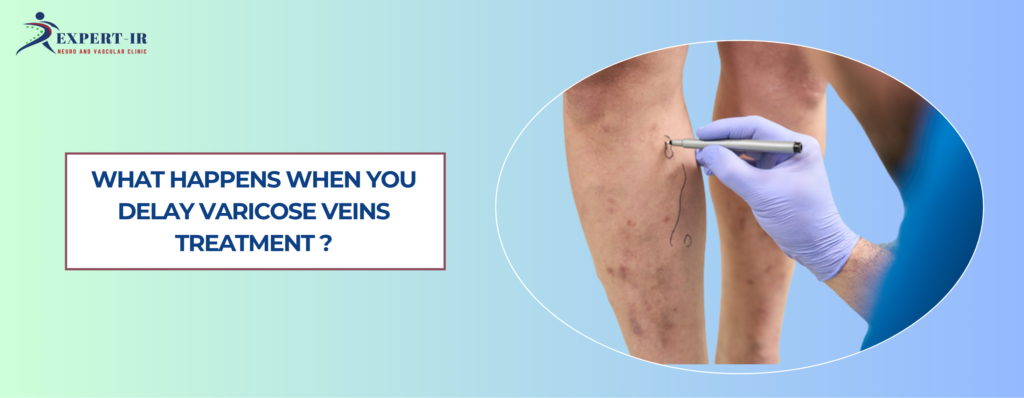
When Should Your Leg Cramps Mean Consulting the Best Vascular Surgeon in Pune?
See a vascular specialist immediately if your leg pain or cramping appears alongside swelling, skin changes, or heaviness that worsens after standing — this is not ordinary tiredness. It is a warning sign of venous insufficiency.
Most people self-diagnose leg cramps as dehydration, muscle strain, or poor posture. For a short-lived cramp after exercise, that may well be true. But there is a clear clinical line between benign muscle fatigue and early vascular disease — and crossing it without medical attention has consequences that compound over time.
Symptoms That Mean You Should Not Wait
These specific patterns indicate vascular involvement, not just muscular fatigue:
- Leg pain or cramping that appears at rest — particularly at night — is a red flag for compromised venous return
- Ankle or calf swelling that does not reduce fully overnight despite elevating the legs
- A heavy, dragging sensation in the legs after standing for one to two hours
- Visible, twisted, or rope-like veins on the calf, thigh, or behind the knee
- Skin changes near the ankles — darkening, redness, or a leather-like texture (called lipodermatosclerosis)
- A vein that suddenly feels hard, warm, or tender — this may indicate superficial thrombophlebitis
Any three of the above appearing together in the same leg warrants an urgent Doppler ultrasound — not a wait-and-watch approach. The right specialist to see is not always a traditional surgeon. At a clinic like Expert IR, the first step is a non-invasive vein assessment that tells you exactly what is happening inside your venous system before any treatment decision is made.
The honest reality: patients who see a specialist at this stage often need a single, same-day procedure. Patients who see a specialist two years later, with skin changes and swelling, often need a more complex, staged approach. The window for the simplest treatment closes as vein disease advances.
What Role Does an Interventional Radiologist in Pune Play in Non-Surgical Vein Mapping?
An Interventional Radiologist uses Duplex Doppler ultrasound to map faulty veins with millimetre precision — without cutting, injecting dye, or hospital admission. This replaces the need for exploratory surgery and gives both doctor and patient a live, visual map of exactly where the vein system is failing.
Most patients assume that diagnosing a vein problem requires blood tests, MRI scans, and days of results. The reality at a specialist centre is considerably faster — and more informative.
What Duplex Doppler Vein Mapping Actually Shows
A Duplex Doppler scan performed by an experienced Interventional Radiologist in Pune visualizes:
- Which specific veins have failing valves — the exact anatomical cause of reflux
- The direction and speed of blood flow — confirming whether blood is flowing backward (reflux) into superficial veins
- The diameter and depth of the affected veins — determining which treatment technique is most appropriate (VenaSeal, EVLT, or Sclerotherapy)
- Perforator vein involvement — the connecting veins between deep and superficial systems that are often the hidden culprit in recurrent disease
- Deep vein patency — confirming that the deep venous system is clear before any surface treatment is planned
This granular mapping is what separates a well-planned, targeted treatment from a generic procedure that misses the origin point of the reflux. It is also why the same Interventional Radiologist who performs the scan will perform the treatment — the information gathered informs every decision made in the procedure room.
For patients researching their options, understanding the stages of varicose veins helps contextualize where their current symptoms sit on the clinical spectrum — and how urgently imaging is needed.
What Happens If You Completely Delay Advanced Varicose Veins Treatment?
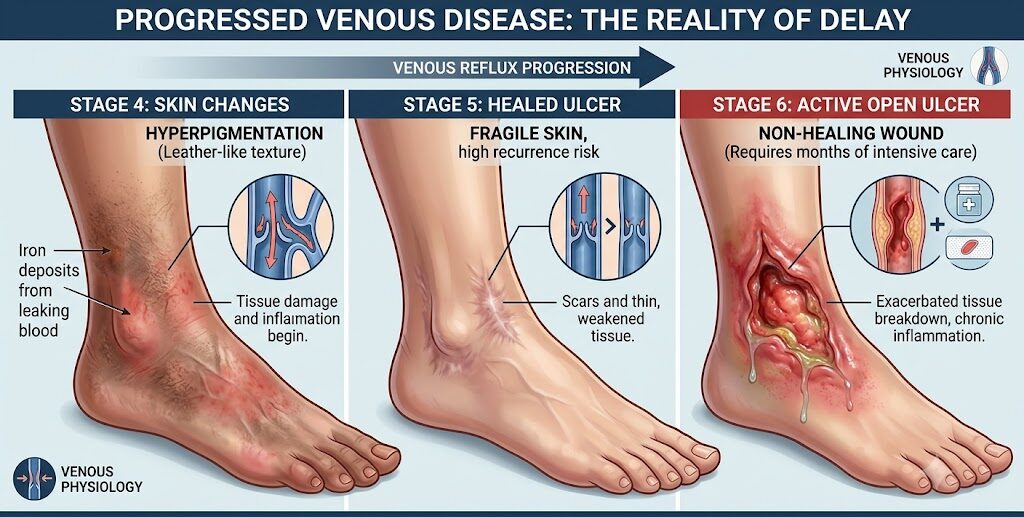
Untreated varicose veins do not stay the same — they worsen predictably through six clinical stages, ending in non-healing ulcers, blood clots, and permanent skin damage. The question is not whether the disease will progress, but how long you have before the next stage arrives.
This is not a scare tactic. It is basic venous physiology, supported by decades of published clinical evidence on chronic venous disease progression.
What Delayed Varicose Veins Treatment in Pune Actually Costs You
Here is what the six-stage progression looks like, written plainly without medical jargon:
| Stage | What Is Happening | What You Will Notice |
|---|---|---|
| Stage 1 | Tiny spider veins forming; no valve failure yet | Fine red/purple lines on skin surface |
| Stage 2 | Visible varicose veins; valve reflux confirmed | Bulging, twisted veins; mild aching |
| Stage 3 | Ankle and calf swelling; fluid leaking into tissue | Persistent puffiness, tighter shoes by evening |
| Stage 4 | Skin changes; iron deposits from leaking blood | Darkening, itching, hardening skin near ankle |
| Stage 5 | Healed ulcer — but disease is active | Scarring, fragile skin, high recurrence risk |
| Stage 6 | Active, open venous ulcer | Non-healing wound needing months of treatment |
Most patients seek varicose veins treatment in Pune at Stage 2 or 3 — where a single outpatient procedure resolves the problem. Patients presenting at Stage 4 or beyond often require sequential treatments, longer follow-up, and in some cases skin grafting for ulcer management.
The Financial Cost of Delay Is Real
A Stage 2 varicose vein treated with VenaSeal or EVLT at Expert IR costs ₹50,000–₹1,20,000 and is resolved in a single session. A Stage 5 or 6 patient arriving with an active ulcer faces wound management costs, multiple Doppler scans, compression therapy, and repeated clinic visits that can collectively exceed ₹3,00,000–₹5,00,000 — and take 6–12 months to resolve.
The smartest financial decision a patient can make is to treat varicose veins at the earliest symptomatic stage.
Why Expert IR — and Why Dr. Santosh Patil Specifically?
Choosing the right clinic for varicose veins treatment in Pune is not just about the procedure — it is about who is holding the probe during your Doppler scan, and who is holding the catheter during your treatment. Those two hands should belong to the same specialist.
Dr. Santosh Patil — Director and Chief Vascular Interventional Radiologist at Expert IR Neuro and Vascular Clinic, Pune — trained at Lokmanya Tilak Municipal Medical College (Sion Hospital), Mumbai, under Dr. Mathew Cherian and Dr. Pankaj Mehta, two of India’s most recognized names in Interventional Radiology.
He holds the record for the highest number of VenaSeal procedures performed among the youngest Interventional Radiologists in the country — a benchmark that reflects both technical volume and patient trust accumulated over years of specialist practice.
At Expert IR, the entire pathway — scan, diagnosis, treatment, follow-up — happens under one roof, with one specialist. There is no hand-off between a diagnostician and a separate surgeon. That continuity is a clinical advantage, not just a convenience.
What patients consistently value about Expert IR:
- Same-day Doppler and treatment pathway at a single appointment where appropriate
- Complete range of non-surgical vein treatments — VenaSeal, EVLT, Sclerotherapy, Foam Ablation
- Walk-in, walk-out procedure format — zero hospital admission required
- Transparent pricing before the procedure, not after
- Clinics in Baner and Kharadi — accessible from across Pune, Wakad, Pimple Saudagar, Viman Nagar, and Hadapsar
- For a detailed breakdown of treatment options available, visit our comprehensive page on varicose veins treatment in Pune.
Final Thought
Leg pain and swelling are your body’s way of flagging a problem that gets measurably more expensive — medically and financially — the longer it waits. The best vascular surgeon in Pune for your specific condition may be a specialist who never picks up a scalpel: someone who maps your veins precisely, treats them that same afternoon, and sends you home the same day.
At Expert IR, under the care of Dr. Santosh Patil, that is not a promise — it is the standard operating procedure for hundreds of patients across Pune every year.
Call: +91-7045209025 Email: expertirclinic@gmail.com Baner & Kharadi, Pune
Frequently Asked Questions (FAQs)
Vascular cramps tend to worsen with standing, improve with leg elevation, and come alongside swelling or visible veins. Muscular cramps follow exertion and resolve with rest. Any persistent pattern with swelling warrants a Doppler scan.
Not necessarily. For non-surgical vein conditions — varicose veins, varicocele, DVT, pelvic congestion — an Interventional Radiologist delivers comparable or superior outcomes with no incisions. Always ask whether your condition has a non-surgical alternative.
No. Varicose veins are caused by structurally damaged valves that cannot self-repair. Without treatment, they progress through clinical stages. Compression stockings slow symptoms; they do not reverse the underlying disease.
Duplex Doppler ultrasound is the gold standard for varicose vein diagnosis — it visualizes blood flow direction, valve function, and vein diameter in real time, with no radiation exposure and no invasive procedure.
VenaSeal is a medical-grade cyanoacrylate glue injected through a catheter to seal varicose veins permanently. It requires no compression stockings post-procedure and has a strong evidence base for long-term closure rates.
Most VenaSeal or EVLT procedures take 30–60 minutes. Patients arrive, have the procedure under local anesthesia, rest for 30–60 minutes, and leave. There is no hospital stay and no general anesthesia.
Treatment costs at Expert IR typically range from ₹50,000 to ₹1,20,000 per leg depending on the technique and disease extent. A personalized estimate is shared after the Doppler assessment.
Yes. Severe, untreated varicose veins can progress to superficial thrombophlebitis or, more seriously, contribute to Deep Vein Thrombosis (DVT). This is one of the primary clinical reasons for early treatment.
In most cases, one leg is treated per session, with the second leg addressed 2–4 weeks later once healing is confirmed. In some cases with lower disease burden, both can be addressed in a single visit at the clinician’s discretion.
Treated veins, once sealed, do not re-open. However, new varicose veins can develop over time from other valve failure points, particularly if risk factors like prolonged standing, obesity, or pregnancy are ongoing. Annual monitoring is recommended.